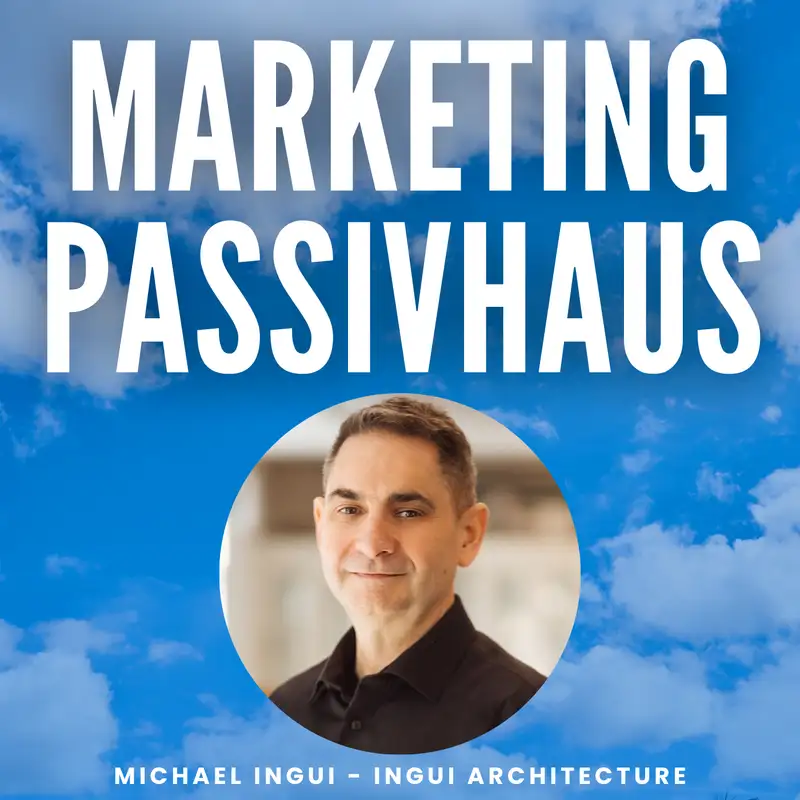
Michael Ingui - Ingui Architecture
40 - Michael Ingui - Ingui Architecture
===
James: Hello, and welcome to Marketing Passive House, the podcast where we hear from architects, designers, builders, suppliers, owners, and other experts in the Passive House and high-performance building space. We'll be talking about what's working and what's needed when it comes to marketing buildings that meet or aspire to the Passive House standard.
James: I'm your host, James Turner, and today I'm joined by Michael Ingui, artist, architect, president and partner at Ingui Architecture, co-founder of the Passive House Accelerator, and co-founder of Source 2050. Michael, welcome to the show.
Michael: Thanks for having me
James: It is my pleasure. Before we get into it, and for people who are just meeting you for the first time, could you share a little bit more about who you are, what you do, and how you started on your Passive House journey?
Michael: Again, for having me. I have been an architect for about 30 years or plus. I'm old now. And I think my first Passive House experience was working next to Sam McAfee in Brooklyn about 12 or 14 years ago, we both did some really incredible houses next to each other, and had all sorts of incredible stuff up and down, and bells and whistles, and control systems, and boilers, and in-floor heating, and you can think of, and his didn't. His was super simple. Had a fresh air system, which I had never heard of before ERV. And I hired him. I was in. I was like, "Oh, I, I want that." And and I feel like that's a good entry point for a lot of architects because seeing is believing. A lot of us don't like being the first.
Michael: And my first Passive House after that was Manhattan's first Passive House. It was a townhouse, and it was actually, and may still be, one of the only passive LEED platinum houses. I had a client who really believed in both. Was really helpful. The job was a lot of fun. I learned a lot. We got our entire office certified which was really helpful. And that was really the start of a really fun journey of of learning everything we had been doing wrong forever and how to do it right. But it really started our our dive into creating a systematic approach for making it better and faster and more repeatable. And that's really what brought everything else afterwards.
Michael: It was really to make sure that that it worked for our office. We're a design office. We're still a design office. I still, although we're all certified we outsource it all. I work with Ed May and John Mitchell on a lot of my projects now from BLDGTYP. And if I can do a Passive House, anybody can do a Passive House. And we're looking at it for the right reasons. We're looking at it as, as designers, and it fits our projects quite well, and it allows us to do cool things we couldn't do otherwise
James: Nice. I, Okay, the first question that comes to mind when you said that you got the whole office certified, and you mentioned that twice, I think that's really interesting. I feel like alignment is a big piece of making Passive House work. Up-- So I, I'm curious to know some people could just have like a, a Passive House department or
James: So what was your thinking there?
Michael: So I think whether you're looking at this from a perspective of someone working in an office or a contractor or a client, the systems and details of Passive House are no longer the issue that we're having to work hard for. It's knowledge, and it's spreading that knowledge, and it's education, and it's conversations like the one we're having today. And you cannot unlearn these incredibly simple tricks that you learn in Passive House. once you learn them, you're in. You don't n- need to be an expert. My clients don't need to know everything, but they just need to know a few things, and all of a sudden they want that thing. They didn't know they could have it. My... The people in my office know to design a certain way 'cause they know it existed. They don't have to be experts. They just need to know a certain amount. And if they in the room they just don't... they don't have that, that sensibility, and it's super basic. I think that's one of the really interesting things for me. This is really not technical. We make it technical, I think, maybe 'cause everybody's gotten so into how far past Passive House we can go. But it's really super basic. But getting everybody to learn how to do it, I think, is a is a... I think it's really, It's good for them, but even if you were just thinking of this from an economic standpoint, it makes for a faster workplace, a better workplace, and an easier workflow.
James: Nice. Yeah, I've heard it said that Passive House is m- more than anything just a learning curve. Once you're up it, you're done. You're good.
Michael: yeah.
Michael: Too hard to unlearn it. Some of the simple things that we've learned, don't do thermal bridges. Before I heard that term, I didn't know what that was. They don't teach in architectural school, which is bananas. But now that I know what it is, I see it everywhere, and so does everybody else.
Michael: So do all my contractors.
James: Right
Michael: the contractors who have gotten trained on our projects, they can't do things that have thermal bridges. They just cannot do it. They know what it is, they stop the architect they're working with. They're like, "Hey, listen, can I please put some insulation here?" And and they know that you can't unlearn it. All of a sudden they've learned, they're in. And so we think about Passive House as this big kinda scary thing, but it's just really a series of like better ways to build. It's super easy once you learn them
James: And have you found that the, that feeling you had when you first, when you said, "I want that," his is simple and better.
James: Do you find that coming, going back to that helps? We're ev- we're, we're gonna talk about marketing Passive House. So
Michael: Yes.
James: do you find that it helps when you're talking to people who don't...
James: I guess potential clients or potential collaborators but I was thinking of clients in particular. Do you find that it's the same thing for them, or is there a different way for getting that sort of aha moment?
Michael: I think there's a different way. So it's funny, I've never really described the story this way before, but I guess I should have already 'cause I've talked about this a lot and a lot of people have heard me say these words, but they may be ne- not in the context that I'm giving it to you here.
James: To scoop
Michael: know that it was hard to sell Passive House until I went to my first Passive House conference. And which is really interesting 'cause the-- what I'm talking about with my clients and again, take it all with a grain of salt. I do high-end residential. The only people not doing Passivhaus who do high-end residential are people who don't know it exists.
Michael: 'Cause once they do, they're doing it 'cause it's better and it's cheaper for the kind of work I do. I am not spending more. So we get into this I usually... i'm doing a lot of historic projects, retrofits and and although most people would find these dif-- be the most difficult projects, especially on the residential end and with landmark-protected homes in New York City, once you learn how to do it you're in.
Michael: And when I walk through these houses that are gorgeous on the outside, they've had five lives on the inside. So very often I'm usually just telling my clients what I can do for them if we do a Passivhaus, which is super easy. If you wanna have less bugs and dust, I could do a Passivhaus. If I don't wanna hear that street noise outside, I could do Passivhaus windows. And if you wanted filtered fresh air twenty-four/seven, we can do a Passivhaus and we'll do an ERV. And they're in, and they've stopped me already. They've already stopped me. Because they don't... They never knew they could have filtered fresh air. Nobody ever told them they could have that.
Michael: They buy a little air purifier, but the air's already bad. It's already in the house. Like, why would I ever let that happen if I didn't have to? I'll take the dirty house. I'll take it. Let's save money on that. Bring the d- bring the bugs in.
James: Right
Michael: nobody does that afterwards.
Michael: It never gets value engineered out. And I've got lot, lots of people who will value engineer out, the certification end of it, but not the other parts. I never even got into with most of my clients that we'll do a lot less mechanicals or that I barely need to heat these houses. I almost never get to the energy savings. I I just never get there. I don't even have to, 'cause people want to live in healthier homes or be in healthier environments. They just didn't know they were right. And I think in terms of marketing Passivhaus, for me I would just beg people to focus on the amenities and beg people to just to stop with the with the title of Passivhaus.
Michael: Just get there eventually. You could talk about what it's called at some point, when you think about all these wonderful codes that people are building towards, knows the code number. I don't know what half these code numbers are, but we're all building towards it.
Michael: I just know what I need to do to hit the code. So if we just focused on marketing what people would get out of it, everybody would want it. Everybody wants these things. I find it to be super easy, but I never thought about it before. when I went to my first Passivhaus conference and everybody's talking about how difficult it is and, s- stop telling them how you do it. They don't care. Some do, but you know- you buy a beautiful electric car. I don't even know where the battery is. I don't know. I don't know how it works. I don't know where the inverter is. I don't know what version they used.
James: It's a very good point. I remember we were on a, one of the either Passive House Accelerator or Reimagine Buildings calls, and you had this... You were-- You would say if you want that, I could do things the way I do it when I build passive houses," and you just kinda slip the word into the conversation.
James: But if they don't pick it up, that's fine. They're focused on the actual thing you're telling them they can have, and then maybe after a while they'll say what is this passive house thing?" And in that case, yes, then it's worth explaining. But
Michael: Yeah. And
James: yeah.
Michael: For me, it winds up becoming problematic if I'm not doing it. It also... When, there's lots of people who've got a market Passive House to clients, one, another, and contractors the third. And so for an architect, the way I would market it is it de-risks your practice. I no longer put Passive House as a line item in my a-additional services. I, I put certification in my additional services, but my Passive House consultant is baked into my schematic design development, and construction drawing hours 'cause I am always having them in there. I can't imagine not modeling a house anymore. I can't imagine not being able to go back and forth on window types and insulation depths and how, and, how breathable my wall needs to be versus not in some areas. Or there's so many things that we work on all the time, and I've got them in for hours in construction services as well because nothing really goes well there.
Michael: And then what I do in my projects, which the way you sell it to a contractor, especially a new contractor coming in, is it de-risks their construction. very often the contractor doesn't have any-anybody, especially in a retrofit market, helping them not make a mistake and have a moisture situation where they don't want it and have a service issue, a year later.
Michael: And they're afraid to do it because they can't upcharge for it. What if the architect put in ten hours for a Passive House consultant and required the blower door as a tool, and it shows them the issues? And everybody knew that tool wasn't to show the mistakes the contractor made. That tool is to show where the additional holes are, and we had an allowance in to fill those holes and to deal with that before they closed in. These are the things that we do on all of our projects now because it de-risks it, not just for the contractor, but for us and the client. And our client is sold on the process. So I feel like it's the way it's marketed, it's the way it's described. It's just better construction, and getting caught up in, in all the other pieces makes it too complicated. And and again, nobody cares. Nobody. A few people, but
James: Yeah.
Michael: gonna pay for it
James: Or those people would've found it anyway. You don't need to market to those people. They're,
Michael: No,
James: they already know. They care. Yeah
Michael: who are dying to be in the Passive House meetings with us, and they are,
James: Yeah.
Michael: in, and
James: Yeah
Michael: all the way up and down. I have a... I had a client who was with me. We had... We did one house where it was a retrofit, so we only had to be at one air change per hour, and we were already below .6, which is happens with us a lot.
Michael: We have a lot of contractors who can just do it, which is great. And then my client was there for it, and we usually have pizza and some beer ready, when we hit it and my client was like, "Let's do it," and n-none of the... Nobody was there with them, everybody's still running around with their smoke sticks trying to get below, the...
Michael: Now can we get below .4, point... At some point no, who cares? But three hours later and the pizza's cold, and now they have a beer. And they got down to .35 and they're into it. They're sold. The contractor's excited about it. My client's excited about it too. He didn't even realize, like, how tight everybody wanted to be, and all of a sudden the client's looking at the contractor in a different light.
Michael: It's a f- the whole situation's kind of fun
James: That's cool. Have you ever had it where the contractor becomes your ally in keeping the, the client on board? Yeah
Michael: Yeah. Yeah. I think at the end of the day, I think as Kevin Brennan puts it Passive House is a team sport.
Michael: I, I feel once everyone's done one or two of these and they realize just how much it de-risks the construction process, you really wanna do it all the time, or at
James: Right
Michael: those safeguards in all the time. And I wanna get into certification just for two seconds.
James: Yeah
Michael: even when we don't certify, we use the certification protocol all the time. We have already made that mistake on a project where incredible team contractor. I walk in, they already started doing some of the framing, and I saw stuff that just wasn't gonna work.
Michael: I'm like: "What are we doing?" They're like: it's not certified." I'm like: "Oh my God. Oh my God. Please stop." And I was like: "Thank you so much. A, I'm gonna quote you..." This is eight years ago. "I'm gonna quote you forever. And B from now on we're following all the certification protocols," which is super interesting because now everybody's so used to them, they don't really cost more for us. And then all certification is after that is just a small bump to make sure that you're following what Phius or PHI would want. And using PHI and Phius a-as tools, the folks who work there are really smart, and nothing ever goes the way you think it's gonna go. And having someone like that to also use as your guide...
Michael: So again, marketing to Passive House would-- to architects would be that. Where else are you gonna get that? Who-- in, in a typical construction, who's your Phius? Who's your PHI?
Michael: Where is your Passive House consultant checking out your details to make sure you're not gonna have problems? There's a lot of really good things for architects
James: Yeah. That's interesting. I hadn't thought of it in terms of just-- yes, it's a tool, but w- when you said that, it made me think of that sort of that problem of, wh- when you're teaching like high school or whatever and your students get to the point where all they care about is, "Is it on the test?"
James: And so if they know it's not on the test, it's like it doesn't matter. That sounded
Michael: true.
James: right? Like it's, if you think of certification as this top-down stick thing, then if you're not getting certified, ooh, we can get away with dot. But if you're looking at it as a tool to help you do better, then that's a whole different ballgame.
James: Yeah.
Michael: So true. So true. And then, w- with the accelerator and Reimagine that you-- I know you're involved in both. That, that's been just my other kind of s- superpower with all this, just being involved in those groups and, we've got an issue with a hot water heater or something else, and I just message the group, and I get answers from the best i-in the universe, like who are actually responding in a group e-environment.
Michael: Or someone else asks a question and I'm reading what they're doing, and I'm like, "Oh, I have that problem too." It's a really interesting community, so that's another selling point. again, maybe more to the architects and builders than the client. It's a really interesting community of people who share
James: Yeah. Yeah. So let's talk about the accelerator. It's an, in line with the idea that Passive House is a team sport, I feel like Passive House Accelerator is the team of sorts
Michael: so it... What, what happened was I went... I used to go to a bunch of... I still go to a bunch of conferences and I talk and I realized that not a lot of what was being Discovered at these conferences was being shared broadly. And and then I would go to different groups conferences, and different groups aren't sharing it with other groups.
Michael: Or I'd go to people who are tangential to Passive House were very similar so where, they're doing LEED or doing something else and those are also really great lessons. And I was just, I just was I really, I always want everything to be accelerated. I or-- and I'm a big fan of collaboration.
Michael: It has done very well for me my whole life. I have collaborated with everybody. I collaborate with competitors all the time. I meet with people I compete with all the time. I always have. It is fun, and it has always benefited me. So I was like, "Oh my God, we just need to do this. We need to do it."
Michael: And I wanted to do it, and I don't really know how to do it, and it's not really what I do well. I'm not a technical human. And I was with Ed May in China, and we were speaking at a Passive House conference there, Ed was building this cool tool. Then I realized this other guy from from Greece was also building a tool that was super similar.
Michael: And then they both realized that they were in a session with someone from China building a tool, and this guy from Australia was there, and he was building something also that's really similar. And I was like, "Holy, oh my God." I'm like, "I am building the accelerator when I get back." And I did. And I just started it, and and it sucked, and, but it was a place where everybody could collaborate. And it wasn't... It's not group-centric. It's not certification-centric. It's project-centric. And and eventually Zack, I realized Zack was available, and I was not... I was friends with Zack. I knew of Zack, but the Zack I knew, gave these keynote speeches that anybody would follow him into anything he wanted to do in life.
Michael: And I was like, "That's the guy who needs to run this thing."
Michael: So, Zack, really, the accelerator that people know now is the one that Zack helped create. It's not really what I created. And and then Tim is yet the, the next superpower who just really does everything behind the scenes.
Michael: Then we got Cara, and then we've got Mary James, and then and then Jay, who writes. It's become quite a really interesting group. Matthew Cutler Welsh with a podcast.
Michael: We've got Monty and Sean who came with us wanting to do a live. And the accelerator has now become a place where I always hoped it would be, where we're collaborating with all the groups.
Michael: All the groups who are our partners. All, anybody who wants to be with us they're in. And what's also fun about it is we just do it. We think about it, we do it. We think about it, we do it. Just put it out there. We don't care if we fail. We don't have a lot to lose here. And it's a lot of fun, and it's super addictive.
Michael: Super addictive. I feel like, I'm on a lot of the the calls where we're planning for a session as well. And these are people I've always wanted to talk to and they're giving away all of their knowledge. It's just the weirdest thing in the universe. Especially if they've made a mistake they're just dying to tell you all about it.
Michael: Like, where does that happen? So the Accelerator has been a lot of fun. And the Reimagine Building Collective, just to kinda keep going with it is is something that we've wanted to do for a while and is really Zack's brainchild at this point. And it's, it- The question really becomes very quickly, "Okay, I took my certification course.
Michael: Now what? I wanna do something. Now what?" Or, "I am doing it. Holy shit, I, I need to do it better. H- Help me, please." Or like me, I've been doing it forever, but I'm now trying to push the envelope to this or that. "Hey, has anybody done this?" Or, "I really need somebody who does that. Who's, who..."
Michael: Or, "I need a certifier," or, "I need this," or what's happening with me a lot now through Source 2050, the other thing I'm involved in, "I've got a lot of products that want to be certified. W- how do I do that?" And the Reimagine Building Collective has become this incredible, cool place where lots of good stuff happens, and a lot of collaboration happens in a way that is just too difficult to do on the sessions on the Accelerator. The Accelerator is a great place to learn it. It's a great place to be a part of it. It's a great place to look forward where you wanna be. But if you wanted to get some real help in making yourself get there, no matter kinda where you're at in life, the Collective is that spot, and it's been a lot of fun.
Michael: It's been e- even more addictive, unfortunately. It's, So I've actually turned the notifications off on my phone 'cause I find myself, no matter where I am, be like, "Oh, no. What's that? I wanna be part of that conversation." And it's, again, it's people that you never thought you'd have access to, having conversations about everything you actually needed to be successful.
Michael: It's so much fun.
James: I, yeah, I have a bit of a different angle in than most, but I've found that's exactly my experience. Wow, I can just message you and you'll just respond to me and,
Michael: it's weird, right?
James: Yeah. It's really nice. I've, I've-- I saw from the outside looking in that the Passive House community seemed to be one of not seeing competitors as competitors and everyone wanting everyone else doing it to succeed.
James: And to step gingerly into it and find that's exactly how it is, has been really wonderful. It's a good group. And then that-- I feel like that is a part of marketing Passive House as well. It's like, hey, if you wanna make better homes, bonus, you can also be part of this cool sort of nerdy global club
Michael: Yes. Yes. Yeah. And I think it's, What's interesting about where we are right now is and we'll get into the marketing of Passive House, I think, pretty heavily in this piece of it. I think, one, everybody knows how to do a Passive House now. Enough people know how to do a Passive House where if someone didn't know how, there are enough people who wanna help you to do it, no matter what building type you're doing, where they've got that down. Now, there's-- the next questions here they're also gonna bring up is how low carbon can we get that? How many healthy materials can we put inside of that? How many bio-based materials can we start to think about? Should I be thinking about, like, where my product is coming from? Because you've gotten that down, you can start to ask so many other questions.
Michael: Now, it may seem like how many questions can I ask myself? But you're really asking in such a an organized way where they're easy. And again, there's so many people who can help you get there that it's not the problem anymore.
Michael: It's really not. I am 100% convinced the problem is the way it is marketed. It-- The reason why this has not taken off is we are not focusing on the amenities, we're not focusing on the result. We're not focusing on the simple fact that when buildings perform really well and they're really healthy and people are comfortable, you can do sort-- all sorts of other cool things in those buildings. If I'm looking at it from a design perspective, I get to do all the cool stairs and windows and everything else I want in life. And if I'm looking at it from a client's perspective, I get to furnish it and live in it a certain way. I'm not gonna move out in four years 'cause I'm frustrated. There's so many things and we just need to focus on the amenity and what it's like to be in these spaces.
Michael: What is the end game? How am I gonna feel when I'm inside these houses? That is the whole deal. So I'm, I'm-- I was quite excited to be on your podcast. I know that's what you're focusing on. I do 100% think that is the next issue here. Because I'm in a lot of conversations with lots of different people, and it's always the question, what's a Passive House?
Michael: Or, how do I get a better building? And the way you answer that is either gonna be with a blah, blah, blah, blah, blah, or you're gonna tell 'em how it feels to be in one.
Michael: And with one they'll do it, and with the other one, they checked out after your first sentence.
James: Yeah
Michael: it's just super... For me, it's really obvious. But I think it's because I'm not a technical person. I become a technical person 'cause I'm around so many technical people. But I I think I-- because I'm more on the design side, I'm more on the experience side or the artistic side I probably gravitate towards that. but I think so many of our talented people who are in our community are technical. They just gotta turn it off just for five minutes
James: Yep. Yep. I 100%. That's f- the reason I wanted to start this podcast is 'cause I listened to a lot of Passive House Accelerator podcasts, and they were... I'm likewise not a technical person, and they were just there would be parts where I was really into it, and it was like, "How did you get that approved?"
James: Or, "How did you convince this university to build all their whatever?" These big questions. And then it would go into the sort of the details, and I like R-values and ACHs, and I, for no fault of my own, I just tune out, like you say. And so I thought, "Yeah, there, there needs to be a separate place to just talk about this part."
James: And
Michael: yes
James: To be honest, marketing also turns off people's brains. And, the word marketing is also not a not marketed well. I think of marketing as spreading ideas and increasing global consciousness or something much more lofty than I think the reputation it gets, right?
Michael: As do I
James: Yeah. And yeah, we need to find ways to infuse the technical with the humanity, I think,
Michael: I think
James: so that it reaches
Michael: like if... I feel like if you do it, you can also reach audiences you wouldn't be able to u- to reach otherwise. So the next question is, how do we bring it into communities where they're not thinking about that, but they're where the housing is desperately needed, so they're gonna build it anyway?
Michael: How do you get it into building types it's not currently in? How do we get it a little further into code now that we know how to do them? And then I think all of a sudden you, when you start to think about the the, the experience level of it people will want it.
Michael: Let's put one hor- affordable housing complex next to another h- affordable housing complex. One is a passivhaus, one's not. They both hit the market at the same time. If you visited one, that's gonna feel really different from the other, and they're gonna ask themselves why don't I have that thing?
Michael: How do I get that thing?" And then forget about the market rate. The question really is all this market rate building that's going on right now, do people... If people knew what they could have, they'd want it.
James: Yeah.
Michael: They'd want it. They would... They wouldn't buy anything that didn't have it
James: Yep. Yeah, and I think you mentioned affordable housing. It feels-- I, I've said this a few times, but I love the fact that if you were the richest person in the world, you should want a passive house, and if you're the poorest person in the world, you should want a passive house because obviously 'cause it's the, it's better.
James: But it's e- it's even, it's the right choice for affordable housing f-from nevermind like the human sort of give people a healthy place to live perspective, but just if the government owns that building and it's gonna own it for a long time, this is a better investment. So just
Michael: Yeah.
James: the
Michael: I brought up affordable housing common because I think it's the most difficult, It's the most difficult economically to build, so you're really trying to build something as, as, as in-as, as inexpensively, but as well as you can, 'cause it is gonna be ty-typically held for a while. And so what we've learned from Pittsburgh and Massachusetts and New York is you can build them cost neutral
Michael: House where people are happy.
Michael: So then why wouldn't I do that? And so if I can build that building at scale cost neutral, I can start to look at market rate. And
James: Right
Michael: was already gonna spend more money on the materials, I could definitely look at it where I'm doing high-end residential. I think the hardest place to do it cost neutral, honestly, is the smaller single family.
Michael: At three thousand, two thousand square feet, all of a sudden I'm looking at a ten, fifteen percent cost premium. But then you gotta ask yourself the question: how much does it heat every year? If I'm barely heating your house, how quick is that payback? That payback's fast, and it's super healthy.
Michael: Everybody gets upset with me when I describe the benefits, and I only talk about the monetary benefits. My wife doesn't use her allergy medication in my house. Why am I not looking at the health benefits? Again, people want healthy living. They'll have-- they'll do anything for it, and they'll
James: Yeah.
Michael: money on it
James: Yep. Yep. The other thing I thought of not really-- It's not affordable housing related, but it's adjacent, I think, is just like ins- public institutions like schools and the idea that just... Not the idea, the fact that healthier, fresher air helps you think better and sleep better, and so your students will per- learn better.
James: It sounds like a... Yeah.
Michael: schools,
James: Yeah
Michael: you think about retirement homes where people are in those buildings more than they're outside of the building sometimes. There are people doing really incredible work in this field that just makes for healthier, better living on a daily da- and if you're doing it at scale, you can do it close to cost neutral.
Michael: So again, I think we're not dealing with a technical issue of how do you do it. We're then potentially on those at that scale, not dealing with a monetary issue of how much is it. It's just, did anybody ever tell anybody they could do it? A- and it's marketing. It just-- they just didn't know
James: Yeah. So how do we reach those people? How do we reach the people who decide who gets to build the next public housing project? Do you know
Michael: I feel like it's podcasts like this one. It's it's Passive House Accelerator, it's Reimagined Buildings. I feel like getting that word out there, and then I think in those talks though especially in the accelerator, it's making sure that we have enough talks that are geared towards them.
Michael: So I'll give you a good example. Right now in New York where I'm located I do a lot of talks. I'm actually purposely my time, although I'm gonna speak at the Passive House International Conference in Essen, Germany. Besides that, I am targeting realtor talks. I'm talking... i'm targeting community board or other places where people d- never heard the term before or wouldn't have talked about it. some business-related functions I've been trying to get into. There are just things where the banks are where the mortgage brokers are. There's places that once you educate them, again, these concepts are super simple. They're difficult to unlearn. then with those, the way I usually handle them is not by too much of a conversation. I usually handle those just by example. Using myself as an example, I am not a pioneer. I copied off the guy next to me, and I hired that guy. I- so I don't think I'm atypical in this universe. I think people like to see that it's been done and you can do it, too. So when I'm in those conversations, I'm usually just saying, "Hey, by the way, we're in New York right now.
Michael: Did you know this building is gorgeous, this building is gorgeous, building... Do you know they're passive houses? Do you know what that is?" And and all of a sudden, they, they can't unlearn what it is
James: I like that. I have always thought of demand generation as a bottom-up type of thing, but you're describing a, a top-down sort of like a, a bank saying, we can't really give you this loan unless you make it a passive house." That would be a,
Michael: what I
James: an interesting spot to be in.
Michael: es- especially if the bank's part of that note holder maybe they should give money to passive houses and not to other buildings. When you think about it, if one building's gonna last a lot longer than the other be more resilient the oth- than the other, one's the better bet? Whi- which is the better one to have your money tied to? And we should start looking at it that way. And again, may- maybe it's a New York-centric thing where the money rules everything. But very often money rules everything, and so selling it there is super important
James: Sell it there. You can sell it anywhere. No, sorry.
Michael: So true
James: No, just I-- my mind went to, is there an actuary, an actuaries conference? I'm sure there are.
Michael: Yeah, th-
James: Yeah
Michael: are great examples. Just people again who would really... And they'd be, they'd lo- the actual conversation, love the chart.
Michael: They would love it. Here's a couple of buildings, here's the data. A-
James: Yes.
Michael: then tell them what the da- and then describe the data. So you...
Michael: But I think depending on who your audience is I think there's a different marketing aspect, but I do think
James: Yes
Michael: next foray. I do remember when I first got into Passive House the question was, "Oh my God, how do you do this? Oh my God, is anybody ever able to do this?" Then was, "Oh my God, where do we get materials?
Michael: Where am I able to find it? Who sells this thing? What's the lead time?" Now it's lots of people have it to the point where I want to create a marketplace so people can find it. Now it's i- it's not how do I do it, where do I find it, but how do I get more people to do it? I think it's an easier problem potentially, but it's definitely the next challenge.
Michael: So you go with the podcast. I like it.
James: okay. I'm conscious of time, but before we go, I wanted to just talk about Source 2050 for a second, if you, if that's okay. So
Michael: Yeah.
James: how did that come about and how is it going? How is it growing? What's your experience with that?
Michael: to have a multi-vendor marketplace forever. I I do a lot of business with some of the other people in this area. Y- actually, I don't do a lot of business with Small Planet, but I would. They're just not close enough. But they're super knowledgeable.
Michael: And then I do a lot of business with 475. I think probably my products in New York at least do, they do a lot of business with them. But there's a lot of stuff they don't sell yet or period because they sell one product but not another product. And there's just so many products in Europe or even in the US. And not only that, but there are so many startups that are creating new solutions every day. And we need to have a vehicle for companies who say, "Okay, I would convert my product into something that could be used in a passive house, but how do I get it out there?" And so what the Source 2050 does is it's that vehicle.
Michael: It's a simple, Amazon for high-performance building materials. It's a really super simple website, one. But two, it's a systems-based website. It's not just the window. It's the window with the tape, with the insulation, and someone who can tell you how to install it, and it's a window that's been used in a passive house, and you don't have to Google it and wonder.
Michael: They'll tell you which buildings it's been done in. It's someone who can pick up the phone and help you 'cause we've got Kevin Brennan, Shannon Pendleton, John Knapp. It's a really interesting site. We're at lots of people in. We are now working with Healthy Material Lab. We're bringing on a lot of healthy materials. We're trying to work with folks like the Seed Collaborative and others to bring on lots of bio-based materials. The issue in my world is a super simple one, and I know my world's similar to everybody else's world in, in the real world of building. Schedule is everything, literally everything.
Michael: Nothing matters. Nothing matters. I always think it's hilarious when people talk about tariffs. My contractors would pay 20% more to get things faster.
James: Right
Michael: they just when can I get it? How do I get it? And can I buy it right now on my phone? And if you can't do that, they're going to substitute it for something I didn't want them to use. They're not gonna do it. And right now, the way it works with a typical building, I can find all the stuff. There's lots of great stuff online. There's lots of great websites out there that are catalog-like websites that actually do a great job, and I think they're getting better every year. But I would have to call 100 different places to get like my 100 different items, and I'd have to coordinate all that.
Michael: Or I can go to my local building place that has all the stuff in one spot, and I'd be done, and I can keep moving on. And no, it probably wouldn't be good, but it'd be good enough, and I gotta go 'cause I'm in a rush, 'cause I'm on a schedule.
James: Yeah
Michael: real world. So what Source 2050 does is it solves that.
Michael: I... Now, to be honest with you, I do not have the skill set to do Source 2050. It is way above my head. It is it's become a really great, seemingly super simple website that we're about to do a refresh on, by the way.
James: Nice
Michael: there's a whole website behind the website now, which is kinda fun, and we're onboarding about a company a week now,
James: Wow
Michael: We paused on that a little bit. We wanted to make sure we got our systems right, which took a lot longer than we thought it would. but it's the simple things like shipping. Just like the things you didn't think would be the issue or the hurdles were hurdles.
Michael: Solved all of them, which is great.
Michael: And by we, it's really John Knapp, who's my co-founder and the team there. I really love being involved, but I think one of the reasons I love being involved is I'm not doing all that crazy hard work, and it's just really not my skill set. It's not what I do. But I very often will find a cool company, and I'm like, "Holy crap, how do I find it?"
Michael: And I can't, and then I call them. I'm like, "Where do you sell it?" And then I try to figure it out, and I still can't get it. And they're like, "John, please onboard these people, please." And so for me it's just like finding these great solutions and having a good spot for them. And I think that if I had to describe I feel like there's three things that will either let us scale this the way we truly need to or not. One is educating and marketing, what you
James: Yep
Michael: The other one is making sure those solutions work and certifications. And then the third, and I really do think the biggest, is sourcing those materials. And if we-- if they cannot buy it, I don't give a crap what anybody thinks. No one's making any twenty, thirty, twenty, fifty.
Michael: It's all completely impossible right now. That is an impossible goal unless they can buy the materials. And they have to buy them fast, they have to buy them easily, or they will substitute them for something that's not as good day, all day, no matter what contractor you're all talking about. And it's-- and so Source 2050 for me is a, it's a really important thing to get right.
Michael: And if it, and if we get it right, it unlocks a whole other universe. And so I'm pretty excited about it, and I think it will work. I'm more excited about it now than I used to be. It's been a, an interesting journey and a lot to learn. And multi-vendor sites are more difficult than if we just had one vendor for each
James: Right
Michael: That's super easy, or if we warehouse it all. But but this had a lot of hurdles and it's fun to see it flourishing right now, which is good.
James: That's great. That feels like a, a suitable mic drop to land this on. I think you, you listed three things I stand by. That was great.
Michael: Cool. Thank you
James: yeah, thank you. So before we go, where is the best place for people to go to find out more about you and all these wonderful things online? And I'll put them all in the show notes, so don't feel,
Michael: cool. Thanks. I think for the architecture, go to inguiarchitecture dot com, and for the Passive House Accelerator and Reimagine Buildings, just go to the passivehouseaccelerator dot com. And for Source 2050, go to source2050 dot com
James: Easy enough
Michael: Thank you so much. I really appreciate it, and I love-- it's a great topic.
Michael: I think s-really you're hitting on one of the most important things we have to hit right now, which is marketing it and getting that word out
James: Thank you so much, Michael. That's very nice to hear, and thanks for taking the time.
Michael: Appreciate it
James: You've been listening to "Marketing Passive House". I'm James Turner, and I hope you'll join me again next time.