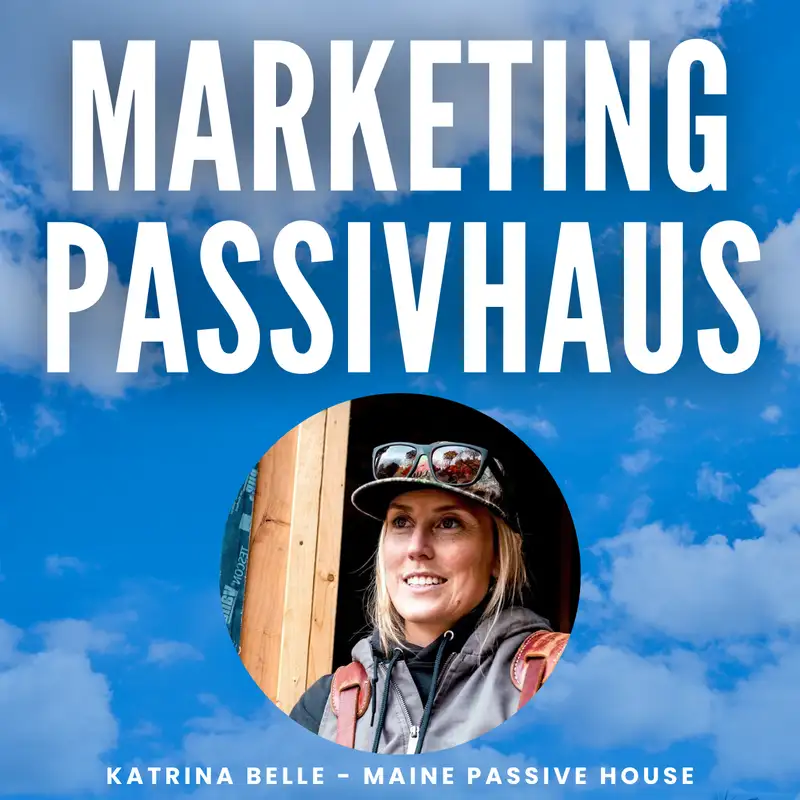
Katrina Belle - Maine Passive House
25 - Katrina Belle - Maine Passive House
===
James: Hello and welcome to Marketing Passive House, the podcast where we hear from architects, designers, builders, suppliers, owners, and other experts in the passive house and high performance building space. be talking about what's working and what's needed when it comes to marketing buildings that meet or aspire to the passive house standard. your host, James Turner, today I'm joined by Katrina Belle, CEO, and President of Maine Passive House. Katrina, welcome to the show.
Katrina: Hi James.
James: It is my pleasure. So before we get into it, and for people who are just meeting you for the first time, could you share a little bit about who you are, what you do, and how you started on your passive house journey?
Katrina: Yes. I'll try not to expand it into too long of a version, but I would say it's been a long journey, and I think the place I'd have to start is in my studies in school, I think as I was growing up and younger, I kind of got into studying human rights in college. Even though I kind of have a math and science background, and it sort of culminated in looking at the extractive industry sector and corporate social responsibility. And I, I kind of like to joke that I essentially studied everything that's wrong about the world and very little about how to fix it.
Katrina: Kinda your classic liberal arts degree Maybe. But I don't regret it at all because I do feel like I learned an extremely in depth breadth of economics, history, all these different combining factors that really centered how I thought about what it was I wanted to do with my life in the world.
Katrina: And at one point, you know, I think I had thought, I was like, maybe I'll go into law or something like that. And essentially the point is when I graduated I just really had this deep sense that I wanted to find a trade or an avenue through which to work. And I honestly, I got into building on site just because I needed to physically work.
Katrina: After my studies. It was just, you know, kind of grappling with everything we were facing as a culture. And then it wasn't long after I started building that I realized I loved it. And then kind of a little bit later was like, Hey, what if this was the avenue through which I worked? You know, the more I thought about it, it was like, all right, well buildings are like 40% of the carbon emissions in the world, and also, I think, chiming off of the, the thesis I did on corporate social responsibility. I kind of just left that with this really deep sense that we need to change the way we live, to just use less, just find out how to live with less. And that doesn't mean like have less of a life. It just means be smarter about how we live. And I, and to some degree, I feel like passive house is like the perfect culmination of that. Because, you know, I, I sort of trended as I was in the industry and learning more.
Katrina: I didn't know about passive house for the first couple of years of building. And then I started working in affordable housing and. I started thinking about the efficiency of the buildings and I started thinking about how much these people were gonna be paying per month on their utility bills.
Katrina: And then of course, you know, the comfort side of things and the, the draughts in the house and the functionality of the HVAC systems. Like was it dumping cold air into the building or was it actually doing something to serve the people who were living in the buildings? And so the more time I spent in that space, I started to kind of.
Katrina: Just basically do some research and figure out how these things could become better. And of course, stumbled into a vast literature of many people who have been working on this for a very long time. And I think when I came across passive house, it was a bit of like a no brainer. It was like, oh my God, this is just so smart.
Katrina: Like, why are we not building every building this way? So that's kind of like the, the quick way in. I think there's also some side currents to the company that I run now, and the people I work with now where it's, it's about the buildings we do, but it's also about how we run the company and how the actual economics are flowing.
Katrina: And I think that I can, you know, definitely trace back to spending a good amount of time thinking about just. How profit is created and the externalities that exist and which are being factored in and which are being left out of our systems. And so I'm thinking about the buildings, but I'm also thinking about the way that the companies are run that are building to buildings.
Katrina: Because in my mind, if that doesn't change it's, it's both and it's both need to be improved. And then I guess, so, you know. A lot of thought throughout the years. And I, I moved back to Maine. I'm from Maine and I've always had a really deep appreciation for the trades. I think because of that.
Katrina: And so I, I kind of just knew I wanted to work in building and got into working with Maine Passive House, which is where I work now, and was really pleased to be able to work in an environment where, so not just that company, but really like the Greater Northeast where there's just this deep network of people who are super passionate about figuring out how to improve building systems and yeah, kind of work on the things that I was talking about earlier.
Katrina: So I've joined that company when in like 2019 or something. From there on out, just have been working to both build the company and you know, work with everyone there to improve the things that we do to be able to do more as a company. Yeah.
James: Amazing. What an intro. There's, I feel so aligned with so many of the things that you said. I love that your social responsibility thinking led you to the built environment. 'cause I think it, it doesn't right? Like a lot, a lot of the time it, it goes to, yeah. More, I dunno, visibly urgent problems or I, I'm not sure how, how to say that, but it's so,
Katrina: I know.
Katrina: I had this deep sense that I needed to like, do something pressing and urgent now to like fix these solutions. And the, the further I dug into it, the more I realized that the, you know, unless we change the demands that are existing on our, like global economy, it's. Like the same things are gonna keep happening, basically.
Katrina: And so I, I mean, I, I fully believe now that everybody, there's, you could work down any avenue, you know, you could work in government, you could work in law, you could work in any sector of the economy and still be working and to some degree on one of these things. I think there was a beauty there were, there were, you know, I could talk forever about this, but like, I really just love, I guess that's why we're here.
Katrina: The you know, what it means, I guess, like you spend most of your waking life in a building essentially, or you're outside to some degree, but like a lot of us are in buildings and they drastically inform how we experience our life and our also connection and relationship to the outside world. I think in appreciation of you know, do we feel connected to that world or do we.
Katrina: It just seemed like there were so many, it was like a never ending well of opportunities to work on different things in our society.
James: Hmm. I yeah, I think the, the better your inside is, the more you can appreciate your outside too, right? Like, if it's drafty and cold, the last thing you're gonna wanna do is go and be colder. But if you've got like a, a safe space to come from and go back to it, it changes your
Katrina: Yeah, it's a, it's a funny like juxtaposition because I guess shelter at its core is to keep us safe from the outside world. To some degree, at least in Maine, you know, I'm sitting, it's like four degrees outside.
James: Yep.
Katrina: so there's a, there's a funny interplay there where it's like you wanna, you know, of course have that shelter component and that safety component, but not lose the connection to the outside world.
Katrina: Think a lot about that.
James: Nice. Yeah, and while I feel like in conversations I've had the, like the whole. thing that where people think that passive house means you can't open your windows and you're, there's a, a way that you could describe it where it feels really like more disconnected, like we're building a little bubble jacket and hopefully we'll never have to interact with the outside world ever again.
James: And it's not like that I don't think at all.
Katrina: No, not at all. And I, I totally hear what you're saying because it's I mean, I experience it too because even there is, there is something to the fact that you know, it's, it's really quiet inside of, of passive house because of the insulation. But you know, nothing stopping you from opening your windows and ways that are advantageous to you.
James: Hmm.
Katrina: This is, you know, a side tangent, but I have this thought about like creating some kind of app where it's recording the nature sounds outside and playing them inside the building so that you're not losing out on that. But
James: Like that, like the LED screen instead of window kind of
Katrina: yeah.
James: then, then we're getting, now we're going down the, into the matrix too far, I think. But yeah, no, I, I, I like that. And, but you mean like the a, not a, not a rec looped recording, but like a, microphone.
Katrina: you know.
James: Yeah. Yeah. I like that. That's, that's a good idea. Yeah,
Katrina: I, I think the most creative design, especially when it comes to like passive house, because I feel like this is what it gets critiqued for a lot actually, is that, is that separation. And I spent a lot of time thinking about how do you make sort of the core of your building, like the conditioned section what it needs to be and, and do what it needs to do for energy efficiency.
Katrina: But you know, in Maine and New England, there's this obviously deep, long, rich history of making use of use of shoulder seasons through like screening porches and sunrooms and, those things still work with a passive house, and I love it when designs kind of like are able to play with the exchange between the outside world and the inside world through those.
James: Yeah, that's a great, a great note, right? Like having the, the inside. That's good. Good point. Good point. You can build it on a, a, you can build out an external infrastructure outside the envelope that can live. A lot of your time in, right? Yeah.
Katrina: Yeah. I could talk, yeah. So long about, I'm not in design, I'm not in the architectural world, but I have no end of fascination in listening to folks who are thinking about, multifamily or mixed use spaces and how to really make use of these elements. I think. So I kind of have, well, I guess I, I did get part of my start in the, in the multifamily space, but it's where I spend a lot of my head space goes into that territory, I think because, I mean, passive house definitely makes sense on the single family level, but when we think towards our
Katrina: future, and this is, you know, my opinion, but as a species, like, there's just so much sense to having our buildings essentially just be closer together and make more use of communal spaces and then keep our like natural places wild, like from a transportation perspective, from like basically every level.
Katrina: And so, I kind of look to projects like you know, there's, there's plenty of projects like this going on. It just reminds me of when I was out in I was out in Wyoming and I, before I moved back to Maine, I heard about the Bayside Anchor Project done by Kaplan Thompson Architects and, A vesta Housing, I think Portland Housing Authority and other partners. And it kind of was like this moment of just like I was, it was so clear to me. I was like, I wanna be doing that. Like, it's not only making the best use of passive house elements you know, solar on the roof, but it also has like community childcare, preschool on the first floor. It's just being very thoughtful about every level. Like not just the building itself, but how it's interfacing with its neighborhood around it. So I always it's not just the passive house component. It's always how it fits into the, like society around it and how it functions in towns and cities.
James: I like that. Yeah, like a sort of logical or ethical alignment at multiple levels. Like if you're, if you're gonna bring communities together, if you're gonna have affordable housing, you should also make it. The highest performing, right? Like the,
Katrina: Yeah, I mean it's, it's hard to argue with like the, the simple like science and math of the surface.
James: Mm-hmm.
Katrina: Surface area to volume ratio, like I think one of my favorite presentations I've ever listened to was by Todd Rothstein from Avesta Housing, and he has this great presentation. They've been tracking performance and operation costs for their, you know, their buildings for a long time.
Katrina: I don't know how long, but I know the presentation was at least from back 20 years. He has this phenomenal slide where he looks at the operational costs of passive house and just essentially proves that they are like 30 to 50% the operational costs of a code-compliant home or like multifamily unit.
Katrina: And that's not just the energy usage, but it's also the service calls and like the need to make like maintenance on the building. I found that I just like fascinating 'cause it's like, it's those things that at least I'll just say like I know, but to have somebody care enough to track that and prove that it's kind of just like the most wonderful thing to see. And I, I feel like I spend, I referenced that data point, like, or those like numbers so many times. So I've been talking with town planners or people who are looking in the development world, and I'm just, I just feel like it's like the greatest, I know I'm biased here, but the, the most clear truth, it's like if you're building multifamily for the love of God build to the passive house standard.
James: Hmm.
Katrina: And thankfully, I mean, I don't know how familiar you're with the kind of standards in Maine, but you know, it wasn't very long ago at all that there weren't really specific requirements. Certainly not related to passive house in the realm of sort of state funds that were coming through. And in 2021, I think was when it sort of first came up.
Katrina: Actually, those Bill ld 15 65, I can't remember what it's, it was
Katrina: LD 1656 which essentially was kind of like a. Attempt to put through, I think it was like 20 million or something for passive house or LEED platinum or living building challenge funded affordable housing. It had a couple other things tied to it and it sort of morphed as these things tend to do in the legislature and came out the other side.
Katrina: And in 2022 finally was passed as a bill that any funds coming through Maine housing, which is kind of like the largest, or like the, the entity that governs the distribution of state funding of affordable housing projects have to be all-electric and essentially like the only way to get there is pass files.
James: Hmm.
Katrina: and that, and that became, I think that all took effect in 2024. So I kind of, I love sharing that story because, you know, it was like five years ago that I was like, oh God, if only, if only like these funds were attached to this requirement and not that long later, it not that long into the future. It is. And so I, I just feel like it's really easy to get lost in not seeing progress or just feeling like things aren't moving along. And, you know, in the past five years, 10 years, there's been really significant changes made. So that gives me hope, I guess. Yes.
James: That's cool. Do you have any idea how that got in or got passed or like what lobbying was involved or?
Katrina: It, I, I don't wanna, I don't wanna mess up the credits there. I know there were I actually think Hans was involved in the writing of that. An architect who was the first, President of the Board of passivhausMaine. So I think passivhausMaine, the nonprofit was involved in that and some other folks in the first iteration of the bill.
Katrina: And then, I don't know these, the specifics of how it transferred through the second, but I do remember writing letters to the legislature
James: Nice.
Katrina: being like, please pass this.
James: That's
Katrina: It's like the single most important thing that could happen.
James: I feel like people listening to this, maybe, hopefully part of what they're looking for is this sort of, like, this to me completely falls under the purvey of, of, marketing passive house. Like it's, it's
Katrina: Mm-hmm.
James: It's another kind of marketing, but it's still marketing.
James: It's still like spreading an idea, convincing someone, Hey, you know, there's this thing that I think you actually want if you knew about it or if you knew enough about it. So.
Katrina: I think a lot about that. So like to that question, you know, the, the core question of marketing passive house, I mean, I'm always thinking about who I'm talking to, of course, because, if I'm, first of all, like, you know, people's, I don't wanna say this in a, that like people's attention span are very short.
Katrina: So I'm always gauging, you know. Exactly. You know, are they really curious or not? And I think. It's not a bad, like most people don't really want to know how their house works, and I don't think that's a bad thing. You know, it's kind of the thing where like if it's working, you're not thinking about it.
Katrina: Like if the government's working, you're not thinking about it. It's it, the, your buildings are kind of the same way. And so I'm always talking and engaging sort of like what level of interest is it there? Like, do you actually wanna know about the systems or do you wanna know, like, the point kind of.
Katrina: And I, I think for most people it's about safety, reliability, and resilience. You know, wherever you are in the economic spectrum. Those are pretty like core cares. And so whether I'm talking to maybe just like a friend this is an interesting point that I don't know how, so it's like if you are looking at a certain demographic that is interested in, maybe is a little bit less concerned about finding housing, for example, example, I might spend most of the time talking about comfort because, and like the product and why the actual product itself is better to live in.
James: Right.
Katrina: I just think it's important to say that, you know, for vast majority of the population, people care about finding a place to live, period. And there's an extreme housing crisis going on, and I can kind of stand here and talk all day about comfort and the benefits of passive house, but I feel like we're really missing the point if we're not talking about like the core need that is existing in our society.
Katrina: And so I feel like when it, when I'm thinking about that. I mean, it just, it's great that there's, I truly feel like the, the answer is also passive house, because back to what we were talking about, the energy bills, the like you know, like the, just longevity of the building.
James: Mm-hmm.
Katrina: It's just great that those things are more equally, if not more so beneficial when it's at scale.
Katrina: So. Always modifying kind of the conversation topic, but paying attention to like what it is people are looking for. Because yeah, it varies greatly.
James: Yeah. Yeah, that's a great point. I remember what, so we met at the passivhausMaine conference last year. And it was kind of like the last day there was like a building walk around and I,
Katrina: Mm-hmm.
James: casually mentioned that I was probably starting this podcast and I said something like, do you ever. Meet with people and talk about passive house to people who don't know about it. And you basically said something like, like, that's all I do all day. So it
Katrina: that's funny.
James: Yeah. Which, which bears out in, in this. And I, I think that's a really good point too about like, it doesn't address the core problem in, in and of itself, and yet if you're building new things, you might as well do them this way.
James: Like
Katrina: Mm-hmm.
James: But, but at, at the end of the day, finding people places to live is ultimately higher up the list. Right? Like if it's, if
Katrina: I mean, I, and I think like, yeah, again, it's kind of picking your audience, but when I'm talking to, like, I would say like my friends or like people like is a great example of you know, the general population because you would think they might know, you know, a bit more about what I do and some of them do, but it's just kind of, it never fails to, and I, I mean this in the best way, again, like back to that point of like, most people kind of don't think about their building systems and so, when sort of people ask, you know, what do I do? I'm kind of like, oh yeah, you know, energy efficient construction, and if there's a little bit more interest, then I'll start to talk a little bit more about passive house. And I think oddly, like the analogy that seems to like break through the best and that like short two minute conversation is often something around the lines of like, you know, oh, like in the winter, like would you rather have like a puffy coat on, or like a thin jacket, you know?
Katrina: Or like. In your cooler, does it work better to have like a better insulated cooler or like a not so well insulated cooler? And that's just such an, like, everyone intuitively understands that. And so I think sometimes that's like a, if you don't go anywhere else with the conversation, sometimes that can be an easy way for folks to be like, oh yeah, that's really obvious to me.
Katrina: So I like that.
James: Yeah. That's a great, that's great. Yeah. Would you like this cooler? It's a little cheaper, but it also doesn't keep things cold as well.
Katrina: Yeah, but she'll have to keep buying ice every day.
James: Yeah, that's right. Yeah, that's a great analogy. And that, that was exactly the question I was leading towards. So thanks for getting there before me. I was like, yeah, what's the, what if, if people have limited attention?
Katrina: Mm-hmm.
James: one. You said safety. I'm curious to know what you meant exactly by safety or, or what, when you said that what you meant.
Katrina: Yeah. Yeah, so I mean, without, you know, oversharing, I, grew up in a house that was an old farmhouse in Maine, you know, and when the wind blew the, like curtains blew, you know I don't think there was any insulation. I know there wasn't any insulation actually in the floor joist or the attic. And you know, we kind of kept the thermostat sort of like just high enough so the pipes didn't freeze.
Katrina: And, money is a stressor, was a stressor. And so I kind of just grew up in an environment where I really witnessed essentially like the, the like very real fear of like the power going out or not having enough money to pay the oil bill that month. And I think that that's something that is like, you know, something crazy, like 30% of the US is like.
Katrina: Has experienced like energy and efficiency or, or not efficiency. Sorry.
James: Energy, poverty,
Katrina: Energy insecurity
James: Hmm.
Katrina: and basically just, you know, some concern over whether or not they can stay warm or cool. And I think that's like from our report, but I'm sure that number's higher. Especially when you think about the extreme heating that is going on, you know, in the southern climates.
Katrina: But here in Maine it's like it's, you know, you don't have to. You don't have to look at a report to look at your neighbor's house and know that they're living out of a camper. Like it's very real. Like the concern about being able to stay warm enough. And so honestly, that's why like I think about energy and I think about security and I think about safety.
Katrina: Those are kinda like the first things that come to my mind because so I, a kind of nice continuation of that story is, my mom finally got a, you know, she got the floor insulated and she got the attic insulated this past year and got mini splits in,
James: Wow.
Katrina: and I can't tell you, she's, she's calling me and she's like, I'm warm in the kitchen for the first time.
Katrina: It's just it's so real. It's just so real. Like how, how much, just a little bit of installation can really make a difference in somebody's life.
James: Yeah. Wow. Thanks. That's a, that's a really poignant story and I mean, yeah. Well, well, in my house, which is not a passive house, we live. Just down the hill from my wife's parents' house and they have a wood stove, and we know, like our, and this is built in the fifties. It's not that bad. And we've had some, you know, cellulose put in the attic.
James: So it's, it's, it's good. It's decent. It's not, it's not in the like, pipes freezing area, but like one day. If, if the power was out for a whole day in, in this, like for me it's like minus 13 Celsius right now. Like we'd have to be somewhere else in very little time. And like yeah, like you say, there's, there's so many houses like that.
Katrina: Mm-hmm.
James: And in that regard, it's, it, it even, it doesn't matter if you weren't, if you could afford
Katrina: Yep. Mm-hmm.
James: The bill, right? Like the,
Katrina: Yeah, I don't think it's that uncommon at all. Like it, you know, it's money aside. Like there's the simple concept that the power could go out and your house would like. Almost immediately freeze
James: Yeah.
Katrina: is it's unnerving, you know, and suddenly, and the concept that you could have, I mean, when we finish our homes, like the, you know, electricity's not, or not on, and we have like, you know, we have a cord running into like a single like tiny electric heater in it,
James: Mm.
Katrina: and it's warm,
James: Right.
Katrina: Or there's no heater at all.
Katrina: And we're like, we're really not worried about anything freezing because we know that. It's just kind of gonna stay at some level of homeostasis unless like the temperature we have, like an extreme cold snap. And so that is just a, as we think forward into just more unpredictable and unreliable weather patterns that are going to be more extreme,
James: hmm.
Katrina: I, I can't think of like anything more important than designing our structures in such a way that we're not reliant. 'cause we don't really know what's gonna happen to the grid in the future and peak demand loads and all that kind of stuff. So I'd far rather live in a structure where, and this is maybe my Maine ingenuity, but like if everything's gone and I'm living independently alone, I can turn on the wood stove and be fine.
James: Yep, yep. Yes. As I said before we started recording Maine and New Brunswick have a lot in common. Rural New Brunswick
Katrina: Yeah.
James: and looks exactly the same. Yeah. you. Yeah, that's a good, that's a good explanation of safety and why safety and and yeah. Who wouldn't want that? Who wouldn't want a house that could last for longer?
Katrina: Yep.
James: Yeah. So multifamily versus single homes when when you're selling them, you're selling to different people. Right. So I'm curious to know if you have any sort of insights from the two different angles, like. Talking to people who are building a house. So, yeah, that's maybe another question I wanna know is when you're talking to people about building a house what they tend to want, like people who are building single family home, like, you know, who are building their own home, what kind of things, like how do you bring up passive house?
James: Do you bring up passive house that kind of.
Katrina: Well, I think what's. Interesting about, so I'll just speak to kind of the work we do at Maine Passive House for, and it's mostly single family homes and whether that's a retro remodel, construction, and. People come to us with very wide, varying degrees of understanding or even interest in passive house. I think a lot of our reputation actually to some degree, is based off of just being very reputable and very transparent and like having very good business operations.
Katrina: So like our. Billing, our project management. All of that's very streamlined. So I guess the reason I share that is because, you know, some people care about Passive House and some people don't. And but we always have that conversation with them, of course, especially if it's a new construction, because it is something we value for all, you know, all the, all the things we've been talking about.
Katrina: And so it's always finding an understanding of like, you know, what it is that matters to people. But I do think.
Katrina: Does it have to be either or, or can we just simply do this better for the same cost? And I, I think something that is if there was like a misnomer that I just wish I could kind of change, it's the concept that like, passive house costs more. And I understand like before, you know, everyone jumps to their defenses.
Katrina: The, the how, the cost of construction. Is kind of at a price point right now where the difference, even when it wasn't, I mean, the difference between a little bit more insulation in your walls and not, I mean, that's like, you know, one to 2% of your project costs, you know, at the most. And if it's, if you're saving on basically having somebody who's managing a project well or, you know, not costing too much, it's, I guess the point being that it's like a very small, there's so many other ways that you could lose money on a new construction project. And so starting from the point of like, let's look at your budget and like, let's pay attention to all the ways that we can get your project where you want it to be, because of course budget is critically important.
Katrina: I think I spend, you know. The most my time in a lot of ways, like trying to make sure that whoever comes to us, we achieve and, and get to their budget. You know, again, coming from that perspective of just you wanna be able to plan on things, you wanna be able to know what you're getting into. You don't want unexpected costs at the end of the project.
Katrina: And so, the question of passive house and budget to me are very intimately tied in such a way that I guess I spend most of my time trying to communicate to people that it doesn't have to be either or. And in fact, oftentimes the things that are gonna make your house more efficient actually maybe make it cost less too.
Katrina: So like funny analogies and, and kind of when embodied carbon wise too, like that's something I. Talk about, and again, people, sometimes they care, sometimes they don't. But let's think about like your siding. If you can supply it from a local mill and it's locally milled pine, guess what? Good for embodied carbon, good for your building, good for your budget.
Katrina: When you think about the building structure, if you're looking to keep your budget to a, you know, a lower price range, having a more simple envelope is gonna be beneficial to you, whether it's passive or not. And then it's also gonna make it easier mean. Honestly, the way I think about, it's like you just have to pay attention.
Katrina: Like that's it. Like if you're, if you are working with people who know what they're doing, you're literally looking at your control layers and you're looking at like the critical joints in the house and you're making sure that it's well air sealed and you have like good systems in place. If somebody's repeating that process over and over again, it's, there's no learning curve, you know, so it's not like we're trying to figure out how to do this every time I build a house.
Katrina: I think a really good example of this is we just completed the, like the lowest HERS score in the country in New Hampshire, and I think it was the first set, like fully certified passive house in New Hampshire, which is shocking. But anyways, the point being that you would, you would think that project would be very expensive.
James: Right.
Katrina: It wasn't. It was $450 a square foot, which if you talk to anybody in like custom home building right now, that's where it is, that's kind of like passive or not. So I think I just talking to folks both on a level of like, if you feel like it's an either or, let's dig into that and figure out why you feel that way
James: Right.
Katrina: If you aren't concerned about passive, no worries. You don't have to. I mean, as long as you're okay with us making your house more comfortable,
James: Yeah.
Katrina: we'll do that. Yeah.
James: Excellent.
Katrina: On the multifamily level, I think those, you know, it's a different set of actors. You know, you're not,
James: yeah,
Katrina: a lot of times it's, it's not driven by the people who are actually gonna be living in the units. Developers housing authorities, construction companies and architects, you know, and so I would like to be in that space more as a company.
Katrina: It's something we're working towards. We're not there yet, but I think that, I can't help myself, but spend a decent amount of time in that space and like the realm of advocacy and thinking about, you know building systems and working on performance and, you know, different projects with people, even if 'cause it, it doesn't really matter what the outcome is, even if I'm not involved in the project.
Katrina: Like, for example, like a town planner and the, the. Town I grew up in just chatting and being like, what's, what is this? What's this about? Like why would I, you know, we're looking at a building project in our area, why would we be interested in passive house? And just being able to kind of get through to the same points of like, oh, well, do you want operational costs to be lower?
Katrina: Like, then you should probably look at this. Yeah.
James: Nice having conversations. That's what I've I think it was actually Hans who I interviewed, and his episode will be out before this one. And that was kinda what he said. Just like, just bring it up, like go to meetings and ask, what about passive house? Like it just puts the word out there in, in, in different scenarios where someone might pick it up and research it or. Come back to it.
Katrina: Yeah, I think the, and so I know you've already had Jacob Racusin on here, and I probably talked about embodied carbon quite a bit, and I, I feel like, you know, it's not, it's not new, but the thing that I'm very excited to kind of dig into next is. Those, the questions of embodied carbon and cost at scale and trying to, just the same way of the energy efficiency, get to the point where you can clearly communicate to people that you actually can do this for the budget you're looking for.
Katrina: And make, you know, it's, I'm always thinking about what substitutions can get made that make sense for the project, you know, and I, and I think that that is essential, whether that's single family, home, multifamily, anything in it. I would never argue for a wall assembly or like a super complicated thing that didn't make sense for somebody for their budget or the retrofit they were trying to do.
Katrina: I feel like it's always what is the efficient level of improvement that we can make without, you know, spending too much in another area. So like, I think. Is like, you know, somebody comes to us with a house that, you know, certain parts are good and certain parts aren't as good. We'll always walk through it and go, well this one, you know, this section would be great if you did this, but we totally understand if that's not in your budget right now, why don't we try and find the low hanging fruit?
Katrina: Why don't we try and find those things that, like, if you add insulation to your floor joist, if that's gonna make a big difference. And so I just, I always feel like it's like critical to not make it this highfalutin thing that's outta, outta touch and out reality for like people are. You know, trying to make the best decisions they can with the resources that have available to them.
James: Nice. Yeah. And yeah, like acknowledging that they're not building scientists, they're not architects, builders, and, and they can't, you, you can't be an expert in everything in your life. Right.
Katrina: Yeah. And you don't want to, I mean, I, I take my car to a mechanic because they know what they're doing.
James: Right. That's right. Yep. This has been great. I really appreciated so many different angles we talked about. Before we go, where is the best people, best place people can find out more about you Online? I.
Katrina: Yeah. I think our, just our website, MainePassiveHouse.com. And we are actually pretty active on social media, on Instagram. Try and keep a live channel of not, not actually live channel, but a good running stream of projects we're involved in, whether that's like community projects or volunteering initiatives or houses we're building or like presentations, that kind of stuff.
Katrina: So, as a company, yeah, we build houses. That's primarily what we do, but we also just, you know, make a you know, very significant effort to sort of give back in any way we can, and that looks like, you know, working with our local schools and that kind of stuff. So I feel like there's lots of ways for us to get involved with folks, whether they're I, it depends, you know, maybe if they're in the area or not, but talking to classes, that kind of stuff.
Katrina: Just be for that same message of like, we want this stuff to be accessible and provide a starting place for folks to get into, whether that's in their career, in apprenticeship or just in like, you know, a one on one conversation.
James: Cool. Awesome. Well, thanks so much for joining me today.
Katrina: Thanks so much for having me.
James: My pleasure. You've been listening to Marketing Passive House. I'm James Turner and I hope you'll join me again next time.