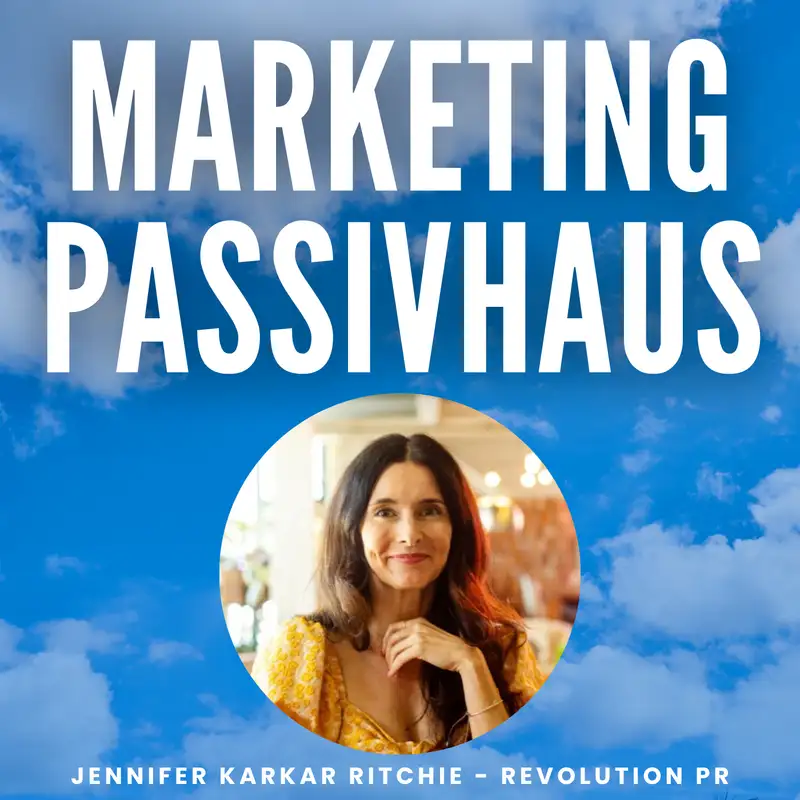
Jennifer Karkar Ritchie - Revolution PR
38 - Jennifer Karkar Ritchie - Revolution PR
===
James: Hello, and welcome to Marketing Passive House, the podcast where we hear from architects, designers, builders, suppliers, and owners and other experts in the passive house and high-performance building space. be talking about what's working and what's needed when it comes to marketing buildings that meet or aspire to the passive house standard. I'm your host, James Turner, and today I'm joined by Jennifer Karkar Ritchie, owner and principal at Revolution Public Relations. Jennifer, welcome to the show.
Jennifer: Yeah. Thanks for having me, James
James: It's my pleasure. So before we get into it, and for people who are just meeting you for the first time, could you share a little bit about who you are, what you do, and how you started on your passive house journey?
Jennifer: Yes. Let's see. So I am a Seattle local. I started my company about 24 years ago after spending some time in emerging technology, and I run a sustainable lifestyle public relations and marketing firm in the Pacific Northwest, and we have the fortunate opportunity of working with clients throughout North America and beyond.
Jennifer: And a section of those clients happen to be in the AEC industry architects, engineering, construction, and passive building. And I say fortune because that was not something-- that was not a sector I sought out to pursue but got connected to a really amazing person and wanted to support his business, which is how we often partner with our clients, and began that sort of trajectory almost 18 years ago.
Jennifer: And I got into passive building as part of a discovery. So in working with architecture firms, I began to learn about LEED and Built Green and lots of different early models of sustainable building. And personally, I was also on a journey to live more consciously and sustainably. I had a friend who was diagnosed with cancer, and when I was with her in that journey, her doctor essentially told her that it was-- he believed it was the things she was putting on her body and the air she was breathing and that it was environmental.
Jennifer: And it just got my wheels turning, and I was, trying to understand all of the all of the ways in which our decisions about how we live and move through the world are impacting us and everyone around us. And so a lot of the early standards really resonated with me because there was, it was about waste, it was about non-toxic products.
Jennifer: We-- I began to learn about how that car smell, new car smell that everybody loves is actually just, toxic. Carpets, like all of those things. It's cr- it's wild, right? And As I began thinking about having a family, I began thinking about the planet and what would the environment be like for them if we continued on this trajectory?
Jennifer: And so I just started to be more conscious about all of those things. And
Jennifer: I don't remember exactly, but I believe it was in a conversation with a really wise person who one day we were working together at a trade show and she said, our demise is gonna come from war over resources." And I was pretty young and I didn't totally understand what she was-- like really I didn't want to understand what she was saying, but it planted a seed.
Jennifer: And when I s- when I learned about Passive House and the focus on reducing energy consumption, it, it clicked for me and it made a lot of sense. And not that all the other things are not important, they are. Ideally people can layer on different standards to live in a home or a building that is the best it can be for them, is nourishing for them.
Jennifer: But I really felt like passive building, Passive House it was at the time because it was largely about houses, was our way forward. So I had the opportunity to build a new home and to choose to build it to passive building standards and see what the experience was like that everybody had been talking about.
Jennifer: And it was not easy because I live in Washington State's first passive home. So there was a lot of learning to be had and, I can just say, the whole story is crazy, but as a marketer, I was like, "Let's put a sign out front when we're building to get people excited. What's happening here?
Jennifer: This is gonna be a passive house, and here's what a passive house is about." So right from the get-go, right from breaking ground, I was like, "We need to start telling people about this so that when it's completed, it's-- we're not starting from ground zero," because it was a l- it's a little confusing when you start to talk about thermal bridging and, blower door tests.
Jennifer: And so w- through my experience and my agency, we began to market this house and market the fact that Washington State was getting its first passive house and what it meant. And so we did it through grassroots efforts, like inviting people in the neighborhood to come and ask questions through media.
Jennifer: At the time, social media didn't exist, but that would've also been a great way, but to really help educate people. And at the time, we tried to talk about the science behind it, but I will say I think science is having its heyday more recently. At the time, I think people were just confused "Why would they do that?"
Jennifer: Now I think we can talk about the science of passive building, and people are really curious about it. My house was complete, and I got to move into it, and there were a few things that had to be changed. So my house is in an urban infill lot. It's three stories high. It was an intentional decision because it's a small lot and footprint, and it abuts another house.
Jennifer: So to be able to get the solar gain needed to draw warmth into the house, because our climate is cooler in the winters, we needed to get higher than the neighbor's house. So the third floor has south-facing windows that capture the sun's heat and energy into the house and trap it inside the house. So this third floor will get warm on sunny days, and in the beginning, it was too warm, and then the floors under us were not warm enough, so we had like these temperature differences.
Jennifer: So we installed in the third floor a house-- a whole-house fan that when it becomes 80 degrees on the third floor, it turns on, and it takes all that heat and sends it to the first floor, and then heat rises. We did also have to add a small in-wall heater into the first floor, Again, because I think just understanding that as a first house, how it was going to work there were some things that we just didn't know.
Jennifer: But there's so much. And so I'm talking about the comfort of the temperature of the house. So the house stays consistently around 67 to 68 degrees. My heater doesn't kick on unless it needs to at s- 65 is I think usually when I turn it on. We don't get really cold here, so I think it's different than from where you live.
Jennifer: Our colds tend to be like lows of 40s. At-- My house in a colder climate would've been constructed differently. It would've been constructed, in a way that adapted to the climate because we used Phius as our certification standard. And the thing that, as much as I really love the temperature, the other things I really love about living in this house, and I wouldn't have known until I did, are it's really quiet.
Jennifer: So when you have triple-glazed windows and doors, and when it... your house is airtight, it's really quiet. The, that comfort aspect and when I tra- I don't notice it until I don't have it, when I travel or when I'm not sleeping at my house, is really, it feels really special.
Jennifer: It also, there's some level of also security because of the way the doors lock in multiple locations to seal them. I also, from an indoor air quality, we had some... We've had fires or smoke from fires that have been in Canada and Eastern Washington, and I can close up the house and turn up the HVAC.
Jennifer: So it usually runs on two. I turn it up to three, and then my house does not smell like smoke on the inside. We have, continue to have,
James: Very
Jennifer: filtered fresh air. It's really cool. And then, I'm run-- I'll exercise in the house and I get to ha-have that experience. So that was a long-winded way of giving you my journey into my house.
Jennifer: Yeah
James: I love two things that I really wanted to talk about, but I'm training myself not to jump in. The, having a child, like having a baby, I think that's a really low-key entry point to this 'cause you're like you're re- you start by researching, the... you're buying all these new things, and you're like: Oh, I don't wanna get toxic things.
James: And then you go down this rabbit hole of like products, and then you're thinking of clothes, and then you're thinking of food, and then you're think- it's just I feel like the, it ends at the house, if you can get to it, if you can keep down that same track of to find like healthy the best qu- if you're searching on Google, the best baby toy for this ba- whatever. I feel like
James: that,
Jennifer: such a good point actually.
James: yeah. It's
Jennifer: it- that's...
James: adult you think about it, right?
Jennifer: Yeah. That's exactly what happened. Here I was having kids. My daughter was born and we moved into this house, so she moved into this house as an infant and, and got to experience living in a house. We also chose non-toxic flooring and, the thing about when you're investing in having a healthy home, you are making that investment through and through, and so investing in healthier products.
Jennifer: And if you're on a budget, then you cut on products. We don't have super fancy light fixtures or, we made other choices because we chose healthy first. But yeah, that's that's such an interesting observation in terms of that life change entry point. And what's really exciting about Passive House is it's grown so much, so now the opportunity to retrofit homes using Passive House standards is really that's also really exciting to me because it's a, it lets people be where they're at and still make some different choices to, have a more energy efficient, healthier home.
James: Yeah. Yeah. It's just, it's not feasible. We wouldn't get everyone to build their own, build new houses, right? Obviously,
Jennifer: Totally. And also there's the, it doesn't make sense. Yeah. It doesn't make sense, right? The whole-- When you think about embodied carbon too, it doesn't make sense, right?
James: Yeah, exactly
Jennifer: the stored carbon in existing homes and buildings. Yeah, it's true.
James: The other
Jennifer: You h- yeah
James: is that you, you started marketing Passive House or passive buildings, and we can talk about the naming stuff later. The naming
Jennifer: Yes. Yeah.
James: a couple times.
Jennifer: Totally
James: but it, you started it by marketing your own house for
Jennifer: I know.
James: education, which I think is super cool,
Jennifer: Yes
James: think of education and marketing as same thing when I think about it.
Jennifer: Yes. That's it. And so then that first year when our house was completed, I'll remind you, I think I had a four-year-old and a just under one-year-old. I decided it was gonna be the year I opened up my house. And so we held tours and we held, I would say I don't know, at least once a month we had people coming through our house to tour it and learn about it.
Jennifer: And when neighbors would knock on the door, I would invite them in and I definitely had to like, after a few months of being like, "We've gotta clean. We've gotta make it perfect," I was just like, "It's just gonna be how it is." And still people will ask me, "Oh, you're the one that built the, you have the passive house," and we'll talk about it.
Jennifer: There is another passive house in my neighborhood. It reminds me, I met the couple last summer and I need to still go have coffee with them. They took it to the next level. Their house is just, was just completed in the last few years. So they also added solar, which in retrospect I wish I would've done.
Jennifer: I don't have a huge roof for a solar array, so at the time it didn't financially make sense. But I do wish now in retrospect that I could have done that and gotten at least close to net zero. I don't think I could have gotten to net zero with the array size, but maybe close.
Jennifer: Yeah.
James: Keep going up.
Jennifer: Yeah, if I, or we could, or like over the rails.
Jennifer: I do have another roof. Yeah. Wouldn't that be amazing? But that's the other part of passive building that in the beginning I didn't even focus on, which is this idea that it's a way to get to net zero. It's the way to get to net zero. So you know, going back to my original like that statement that woman said to me about how, it's all gonna come to a close because of resources basically.
Jennifer: There's, it's another way to even reduce the resource need further. And as resources become more expensive, it does help you navigate that
James: Yeah, just figure out how to need less and then you won't have to fight over as much or,
Jennifer: So right. And there's so much that exists in the natural world that we pay for. You know the sun, for example. So there's, and we have water all around us, but we pay for water, so when you start to think about it in that way too we could do more to harness what we have.
James: Yeah.
Jennifer: Yeah
James: There's a great quote I can't remember who said it, but I always-- A lot of my sources for things is Lloyd Alter, the professor and columnist. And he uses the phrase is sufficiency with-- or efficiency without sufficiency is lost. So like making things
Jennifer: Interesting
James: more because it's efficient is completely
Jennifer: It just doesn't make sense. I know.
James: yeah.
Jennifer: kinda what-- That's actually what has happened across everything, right? I was reflecting with my daughter on being about her age and really wanting a jean skirt, and my mom being like, "You gotta pay for it." And it was $10 which at the time was quite expensive.
Jennifer: Now I think you could go s- to some fast fashion places and pay $3. But but I had that jean skirt for a really long time. And now I think about clothing and how it's become so cheap, and how we just stuff our closets full, whereas growing up, I feel like I had a few things, and I was grateful for them, and I-- that's all I wore.
Jennifer: I still live that way. I like the idea. I have a capsule wardrobe, so I have just a small wardrobe, and then I rent things 'cause I love the idea of the share economy
James: That is very nice.
James: That's again, all feels-- It's all con- it's all connected, right? And it makes sense, like the house is the sort of biggest circle in that, in those concentric circles.
Jennifer: Yeah
James: I suppose you could get the, the community and so on.
Jennifer: And your workplace and
James: bubble,
James: the biggest personal
Jennifer: Yeah, the thing you can impact the most, right?
James: Yeah. Yeah. Shifting gears a little, if you don't mind.
Jennifer: Yeah
James: I'm really curious about your experiences now marketing companies doing passive building and how... a question I'd love to just ask point blank is what do they need?
Jennifer: Yeah
James: companies need? Or what is something that they don't, that people you've worked with haven't realized they needed and then you've found that they did or something?
Jennifer: I think the biggest challenge continues to be how to communicate about passive building in a way that's going to resonate with people and sell it at the end of the day. So it's really the messaging, and it-- you and I talked about this 'cause this is an area of your expertise. But what-- how can you communicate in simple language the benefits of passive house, passive building to various audience to inspire them to care about it and choose it and pay a little more for it?
Jennifer: I think that's part of the messaging is how much more does it cost? I think now people are talking about, builders and developers are-- we're hearing that it's, minimal, 1% to 5% more to choose passive building. So really I would say the number one area that we're working on supporting businesses is how to talk about it, how to message it, how to message it differently.
Jennifer: And then I think, more holistically what needs to happen for passive building and the companies under passive building and Passive House is we need codification of the standard
Jennifer: So I think that part of the messaging work needs to really reflect that that it's a proven way to design and build.
Jennifer: It uses less energy. It's longer-lasting, so the other thing that, we talk about but don't talk about because do people even care about building envelopes is,
James: They do
James: not.
James: Don't think so.
Jennifer: I know, right? But it but maybe a developer does. I don't know, is the idea that, you know, when you build to passive building, your building envelope, you're- you've got 100-year building envelope.
Jennifer: The design of it is long-lasting, and so I, I would say that is the biggest challenges. And it continues to change, when energy's cheap, we can't talk about the savings. It, 'cause pe- it doesn't register with people, and when people are hurting financially, as many people are right now, talking about comfort, doesn't work.
Jennifer: So it's really being able to tune into the why choosing, the why behind it, choosing it, and what are the different messages that you can use that really resonate with your audience? If you would've asked me that question five years ago, I would've said having some basis, basis of understanding, some basic knowledge because now I feel, I believe more people have heard about passive house and passive building, and there's been more press about it and, even in sometimes when it's not correct, even like during the California fires, there was a an article that went viral about the one house that survived the fires being a passive house.
Jennifer: So we're just seeing there's more understanding of it. There's more awareness of it. We're seeing more press coverage of it. So I would, where that would've been a challenge five years ago, just getting a foundation of, knowledge and awareness about it, now it's really like how do we talk about it in a way that people can understand it?
Jennifer: And then the next layer would be the idea that passive building, and I've, I really have consciously switched to say passive building, can be a-- that the passive building standards can be applied to all types of buildings, offices, libraries, houses lots of institutions breweries, and It doesn't have to look the same way. So if you really love a Craftsman style house and you don't want a modern looking house, you can still choose passive building. So I think that's the other, like people have this idea that passive
Jennifer: Homes and buildings have to be super modern. Mine happens to be more modern, but it's not the choice that everybody has to make
James: That's a good point.
Jennifer: What do you think it... What-- I'm curious 'cause I know you're learning. What do you think that they, that the biggest need is? I'm curious.
James: One thing I'm, you said about the legislators I think I'm trying to tease out the fact that there's, you have to market to all these different people, legislators, homeowners, builders, developers. There's... And you have to talk to each one. There's a way that it benefits, that there's a benefit that will speak to each different group, but they're not the same benefits.
James: And so I think as de- depending on y- you know, your status, if you're just doing small one-offs, it might not be the case. But if you're doing bigger projects and you wanna get, onto the publicly funded things or, there's, seems there's groundwork to be done to the, on the legislative side that having a sort of quick and easy one-pager to hand out to people who are gonna be making decisions about policy.
Jennifer: I totally agree
James: I think just like this sort of it's this
Jennifer: And you said it, one pager. It cannot be complex.
Jennifer: You've tuned into that aspect too
James: Yeah, definitely. So yeah, I think that's the thing that I most have noticed. Especially I've talked to a lot of people, now maybe it's because I've talked to a lot of architects, but I've-- it seems like there's a big gap between where the architects are at and where the builders are at, and it, I
Jennifer: Yes.
James: gap is an important part because you can
Jennifer: I would agree
James: but if they can't get it built,
Jennifer: E-exactly. I agree. I think that has been a challenge. I know Phius has done a lot more builder-specific trainings to help bridge that gap. I'm sure that's happening with PHI too. I'm not s- I don't know s- 100%, but I imagine that both organizations want to bring up the trades.
Jennifer: So Phius has a lot of trades trainings focused on bridging that gap. Yeah, and then I think, getting the builders on board, and then the next one is, coming back to us marketers, real estate agents. And so again, I know Phius has developed a new training called Foundations, which is just a really basic understanding of passive building and how to market it, and so that would be another subset of a group because it's pretty special.
Jennifer: So when you go to sell your house, you want to be able to capture what you put into it in that way and make sure that the next person really understands, what they're getting to, move into and experience. So yeah, that's a really good point, that other... And then I would say for a while it seemed like products were hard.
Jennifer: When my house was built, I think the windows and doors came from Poland, like on a ship, and they were s- ordered... Yes, exactly, and I do believe I've heard that it's gotten a lot easier to find, what you need to construct and build f- from the HVAC systems to the windows and doors.
Jennifer: Insulation is, I think, probably pretty standard. But that's the other piece of like how, like talking about how to communicate about Passive House, and I remember early on being like, "It's like a cooler," but then, i- in some ways, right? Because it's so well-insulated. But then I think that analogy people would be like then it's always cold."
James: Yeah.
James: A
Jennifer: and so really having to think about, yeah, exactly how subtle of a change, you can make with how you describe it. And early on our heating system is so small and it-- I was like I, I could blow my hair dry for 30 minutes, be drying some clothes and baking some cookies and not have a he- not have a, a heating system.
Jennifer: My house would warm up from those things. And so I was like, it's, the size of a hair- like a hair dryer. There was some sort of continuity in the amount of energy. But I even think for some people it felt too primitive. So really it's how we talk about it matters and people wanna be sustainable, but they also don't wanna give up the perceived luxuries
James: Yeah.
James: I've brought, I've said this multiple times so if people have heard me say this before, but
Jennifer: Yeah
James: cool how it's the perfect solution for people who don't have much money as
James: in terms of like energy poverty and like being able to have a safe, warm, comfortable space that they can live in with minimal cost, operating cost.
Jennifer: Yes
James: the perfect solution really, if you're on the upper end of the spectrum, if you want it the most comfortable, quiet,
Jennifer: Yes, luxurious, right? You can sell it in both ways.
James: Yeah
Jennifer: that. I think that's so good and so true. And the affordability piece is really important because I do-- it's where the most impact can be made for apartment buildings and homes for people who, can't afford... I don't know what a legitimate or what a typical utility or heating bill is anymore because I haven't had to pay it.
Jennifer: I think, I think mine is like a couple hundred dollars in the winter every two months, and that includes all my electricity and everything. I think y- I don't know. Do people pay probably upwards of $400? I just don't know. So I do think that's a significant savings for people.
Jennifer: I also think you tapped into something we haven't talked about, which brings me back to messaging opportunity. And you said something like safe, but it made me think about like adaptability and resilience and how last month my electricity went out three times in the span of 10 days. We-- I have underground electricity, and apparently it's aging.
Jennifer: So the first time, I was without power for 40 hours in the middle of winter and, my neighbor was like, "Oh my gosh, my house is 45 degrees and it's freezing." And I was like, "Do I tell her what's happening in my house? Should I just invite, should I invite everybody over?" I really was having that, those feelings.
Jennifer: But it's true that, w- as we continue to have climate-driven crises, where people don't have electricity for days and days, y- everybody will fare better in passive built homes and apartments and, it will-- everyone will be more comfortable and be able to ride it out with a little bit more ease.
Jennifer: Yeah
James: Th- which goes to that, setting yourself up to need less.
Jennifer: I know, at the end of the day, right? Yeah.
James: Yeah
Jennifer: Yeah, that's a fascinating way to think about it. What if everyone just needed 5% less? What would the impact be?
James: I always think too of the analogy. I remember it- talking with my mother-in-law about shoes, and she would never spend over, I, I can't remember what the amount was, $100 let's say. Maybe it was
Jennifer: Yeah.
James: $80. But she thought that there was like an upper limit of what she thought was reasonable for a shoe, and I just thought, if you just doubled that, you could probably buy one pair every five years instead of one every year or whatever, and, I feel like Passive House and passive building is the house scale equivalent of that.
Jennifer: I agree. I totally agree. Yeah. The idea of it being well-built. Less about the brand, right? Because I think some people will pay for an inexpensively made shoe, right? Yeah.
James: Shoes,
Jennifer: not, looking for Prada. But yeah.
James: No
Jennifer: Yeah, I totally agree. And that's... that makes so much sense to me. It's how I make my own purchasing decisions.
Jennifer: I really think about the craftsmanship of things mostly because I don't... I think, yeah, I don't really wanna have to keep replacing things. That doesn't actually feel good to me,
James: Yeah, same.
James: Happy to never have to buy clothes ever again if I could get
Jennifer: I know.
James: quote
Jennifer: And have your... I know. And sometimes I pull out a pair of jeans that are 20 years old, and I'm like, "These are the best,"
James: yeah.
Jennifer: yeah. Yeah, that speaks back to the durability too of passive building, which is that, there was like a era or a season of quickly built homes and buildings.
Jennifer: I don't know if you saw that where you are, but we saw it in Seattle, just townhomes and things that went up that you, that were, I don't know what the word is, shoddily built. But, and I had friends who would buy them, and then, the experience was not great. I have continued to watch these, buildings that have gone up, and I've been like, "Oh, those are...
Jennifer: That's beautiful." And then five years later, they're re-siding the whole building.
James: Yeah,
Jennifer: and you're- I'm just like, "Whoa, what happened?" Yeah.
James: Yeah
Jennifer: for sure. Yeah. And that's not sustainable. It all comes back to this idea of what started me here which was just like what's, what is sustainable?
Jennifer: And even when it started with my friend, I was thinking like, it's not gonna be sustainable to keep using this lotion and this perfume and this... i'm go- I will ultimately get sick or, breathing this air. And so I think just I try to think about things from that lens.
James: Nice.
James: Have you found, I think have you found that the com- passive building companies that you've worked with as individuals have had to work through some of those blocks? Like you agree on the building method, but then when you talk about the marketing, you end up in
Jennifer: Yeah
James: needing to convince them of the way to market their own product because they themselves as a human, just as a person in the world, are still maybe more in the other camp.
Jennifer: Yeah, that's so interesting. My experience with passive building clients is l- 100% architect clients, and then,
James: Gotcha.
Jennifer: we work with PHIUS I would say largely no, because they make those choices. But I understand what you're saying and I think this is the situation we all, I think, are confronted with from time to time.
Jennifer: This idea of knowing the right path but not being totally on board with it and having to connect those dots fully to make the decision that, we might deem as the right decision. And but I can see like we're in the builder sector, with my own home.
Jennifer: Just having to engage with people who are like, "Why do we have to do this?" And, "This doesn't make sense. This isn't the way we used to do it, and the way we used to do it worked just fine." And,
James: Yes.
Jennifer: People are set. They have... A lot of people have a fixed mindset and change can feel really hard
James: Yeah, and
Jennifer: Yeah
James: change is
Jennifer: marketing change.
James: It's an uphill
James: battle
Jennifer: it can be, yeah.
Jennifer: Yeah
James: but that feels-- I feel like transformation is different from
Jennifer: I like that actually
James: transformation is like the other side when
Jennifer: It's positive change.
James: But the first, the small steps that get there, I think
Jennifer: Yeah. And there's so much fear associated with change, and the reality is we are changing every moment. When I hear people say "I don't wanna change," or, "You're trying to change me," or I think "Look in the mirror." Every single day we change a little bit.
Jennifer: It's the only thing that's true is impermanence, right? So it's like we can fight it, we can fight change, or we can get curious about change
James: Nice.
Jennifer: Yeah
James: I think get curious could be an interesting passive house adjacent slogan.
Jennifer: Yeah, I like it
James: Passive house. Let's talk about that. So yeah, I've, I've-- I when I started, I wasn't sure whether to call it the passive house marketing passive house or Passivhaus, like the German
Jennifer: Yes
James: And I got convinced through, again, Lloyd Alter
Jennifer: Yeah
James: it's neither passive because,
Jennifer: It's active.
James: immediately has ventilation, mechanical ventilation, and nor is it just for houses. And so his thought was to at least if we in North America used a German word, it doesn't sound like those two words signal the wrong things to people.
Jennifer: Oh, interesting
James: so yeah, I, I had bought both domains and mocked out both titles, and at the last
James: second I switched from the English to the
James: Spelling, just on a w- on a whim.
James: But so you've
Jennifer: Yeah.
James: about this yourself,
Jennifer: I have
James: passive building a lot. I think that's
Jennifer: I think it's the way forward. I th- I get it. Passive House is, it's rooted in going from Canada to Germany. But I also think it signifies a certain way of building, whereas just saying passive and a cert- and a certain type of project, whereas I just th- passive building is all-encompassing.
Jennifer: And in many ways, this is my hope for our planet, which is that, like I said, that it's just the way th- it's the way homes and buildings are constructed or retrofitted or-- and that it's just becomes really all-encompassing and it doesn't... It's standard agnostic. Who knows? There may be other ways of achieving it.
Jennifer: There will be other ways of achieving it beyond I think what the, the two that we know today. I imagine like I don't know this to be true, but I just imagine being in a country like Africa or, and thinking about the ways in which they are building their, the, places that they live and how there probably are some practices that are very similar, or achieve the same things.
Jennifer: And so I don't know. I'm a fan of passive building
James: Yeah, I like it. I
Jennifer: Yeah.
James: feels
Jennifer: Yeah. It's longer. I'll say, Passive House is nice and tight in your logo, but
James: Yeah. Yeah. It would-- I'd have to make a bigger,
Jennifer: Yeah.
Jennifer: Something, yeah. Exactly.
James: Yeah.
Jennifer: Yeah
James: Yeah, the Africa, that's a good point. Places where they over, like tens of thousands of years have just learned how to keep places cool
James: because they've had to.
Jennifer: Yes.
James: Yeah
Jennifer: I know. I know, and it's so interesting to me too to think about because I think about passive building. In my mind, it was more to keep my house warm without having to, have a high energy bill at the end of, every month. But in the Southwest, it's about cooling, and the house functions in the same way.
Jennifer: Same for me in the summer when it's 90 degrees, I have a tiny little, air conditioner that keeps the whole house cool. It's integrated into my heating system, but it's not-- it's much smaller. And also there's no other supportive mechanism to keep the house cool, and the house stays really cool.
Jennifer: So for heating my house, I do have a second heater on that first floor. But for cooling, I don't. So it's really exciting to think about passive building for super hot climates
Jennifer: And just being able to use less air conditioning. Man, that's like my, the...
James: and
Jennifer: Yeah, that's right. Exactly.
James: height. Like I
Jennifer: exactly right
James: idea of calculating exactly where the sun will be coming in
James: At the shortest day of the year, the longest day of the year, like that kind of
Jennifer: It's so true. The same for my house. In the summer I have so- I have shades that go down on this third floor where I capture all the sun. I have exterior shades.
James: Nice.
James: Like they're hard. I, I-- impossible, but I, I-- We have a big sort of southwest-facing, not triple-glazed window, and before
Jennifer: Yeah
James: Mini-split, like air source heat pumps it would get so very hot in the
Jennifer: Yes
James: hot. Like much... I don't know. Fredericton's weird. It's like the hottest hots and the coldest colds.
James: We
Jennifer: Yes, because the extremes.
James: But it was really, when we put in heat pumps, it wasn't about saving on heating costs in our mind. We were just like, "We want air conditioning, and that seems like a smart way to do it."
Jennifer: Totally.
Jennifer: So smart, and that's what a lot of people are doing.
James: our heating costs have gone down
Jennifer: Yeah, 'cause it's... That's right.
James: our,
Jennifer: Yeah, you need an exterior shade on that window
James: Yeah, and I looked into, and it just, it, there wasn't, it wasn't... There's one house that has an awning in the entire city that I've ever seen.
Jennifer: How funny
James: common practice. People are just,
Jennifer: So mine is just a mechanical shade that is outside that just goes down. And they...
James: window
Jennifer: Yeah, and I- it's set up so when it gets too hot, they just go down.
James: Brilliant.
Jennifer: Yeah, you might need that. I'm living in the now. I want everyone to join me. Yeah.
James: right
Jennifer: Yeah. Should we wrap it, James? Because nobody wants to listen to a long podcast
James: Indeed, they do not. Yes, indeed. This has been great. And so before we do go, where can people find you online?
Jennifer: Oh yeah, thank you. Yeah, come visit our website at www.revolutionpr.com. You can also find us on social media, on Instagram and LinkedIn. We often shorten it to @revpr
James: Sweet.
Jennifer: Yeah.
James: to link to all of those
Jennifer: Thank you, and thanks so much for today and the time, and it was great to connect and talk about this. I learned some things from you too.
James: Oh, nice.
Jennifer: It's great.
James: I like that.
James: That's great to hear.
Jennifer: Yeah. Yeah. Thanks so much
James: You've been listening to Marketing Passive House. I'm James Turner, and I hope you'll join me again next time