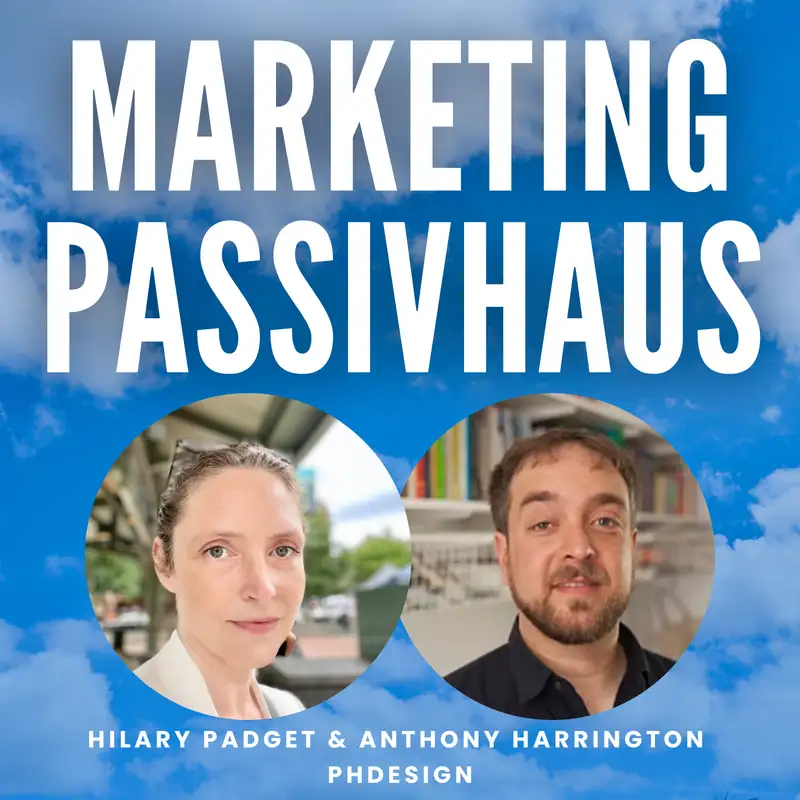
Hilary Padget & Anthony Harrington - pHdesign
43 - Hilary Padget & Anthony Harrington - pHdesign
===
James: Hello, and welcome to Marketing Passive House, the podcast where we hear from architects, designers, builders, suppliers, owners, and other experts in the Passive House and high-performance building space. We'll be talking about what's working and what's needed when it comes to marketing buildings that meet or aspire to the Passive House standard. I'm your host, James Turner, and today I'm joined by Hilary Padget and Anthony Harrington, co-founders of and partners at pHdesign. Hilary and Anthony, welcome to the show.
Hilary: Thanks for having us
Anthony: Thank you
James: It is my pleasure. Nice to have two guests, which is a, a treat for me. So before we get into the meat of it, and for people who are just meeting you for the first time, could you share a little bit more about who you are, what you do, and how you each started on your respective passive house journeys?
Hilary: Sure. I'll start.
James: Sounds great
Hilary: I'm Hilary. So I have a background in fine arts and art history and transitioned into architecture after my undergraduate degree. That time, I was trying to figure out how to apply my interest in sustainability to environment around me and the most practical ways. I didn't really find it in architecture school. I was getting kinda close. Had a course I took in England that focused a lot on traditional arts and building arts, kinda sparked some of my interest initially and I went to graduate school at University of Michigan, which is where I met Anthony.
Hilary: And the two of us had this kind of shared vision, but we weren't quite sure where would go with it. We had this long-term plan of let's have an office together someday, and until we get there, let's learn what we can working for other people and where it takes us. And I think we both learned about Passive House around the same time. but at least in my practice, I didn't really get to use it in the firms I was working for, but it was always in the back of my mind that I wanted to more about it and apply it eventually. and it wasn't until we started working together that we actually got to do that. But it was really exciting once we were able to make that
Anthony: Yeah. And I would just add, like I was s- in scouts and it was like a strong environmentalism bent, right? Yeah. This idea that you're stewards and you need to be thoughtful about, your environment, the planet, et cetera, and figuring out a way to incorporate that into our work. And we...
Anthony: Hilary didn't mention it, but she had been working for the city for landmarks and was exposed to the-- to projects from like Baxt Ingui that were doing passive projects in landmark districts. And at the sort of same time, I was working at a different office Ryall, it was Ryall Sheridan at the time, or Ryall Porter Sheridan.
Anthony: And they were doing a kind of very I would describe it as granola-like project in southern Vermont for a recording studio and a house that was like focused on the materiality of heat pumps and s- ground source heat pumps and some other like energy saving measures. But and at the time, our office had all gone through LEED training, but we all felt like it wasn't really doing the things we wanted to do.
Anthony: It wasn't like we couldn't track the performance in the same kind of way, and that sort of led us to be more interested in like exploring Passive House. And ultimately, we went down this journey for this first project that we did in Northern Michigan, which was with the client as a partner, and we were all learning together to do this project in that way
James: Nice
Hilary: Yeah. Yeah, I forgot to mention the Landmarks connection. I actually did my first passive house training while I was working at Landmarks.
James: Oh, really?
Hilary: in part because I was taking a lot of Mike's projects through Landmarks Commission hearings, and I remember sitting with him one day before a hearing like, "So which trainings would you suggest?" 'Cause I wasn't sure if... I didn't know what the difference was between Phius and PHI at the time. And he suggested I do the PHI training. I took his advice, and it was great. So
James: Nice. Yeah, I've... That's something that really come up that often, but I'm curious g- given the choice between the two what pushed it to one over the other? If you don't mind. I'm not trying to start a, flame war or anything.
Hilary: We aren't either.
Anthony: Yeah
Hilary: agnos- I'm honestly, I'm agnostic about that
Anthony: yeah, I think we both separately came to the PHI methodology, and part of that was my old boss, William Ryall had gone to Germany, I believe, to do the training at that time because it wasn't offered in the US. This was 2000 and I can't remember, probably six or seven. So it was very much like that's the thing to do.
Anthony: We're in New York City, right? It's very PHI heavy. There's not much PHIUS here
Hilary: Yeah. This-- we are in like PHI land New York City.
James: I didn't know that
Hilary: it's pretty... The, the earliest adopters were bringing it over,
Hilary: Here. And that's before PHIUS was even established
James: That makes sense. It kind of maps the migration routes,
Anthony: And New York Passive House was around before PHN, like the North American Passive House Network as it used to be called. So it was in New York City first before it was other places. So it maintained that the PHIness of it
James: Interesting
Hilary: adopters were already PHI trained, and they just kept attracting more people to that standard
James: Right. And then once you're doing one, you-
Anthony: Yeah
James: the work and the results and
Hilary: Exactly. And, I don't have a whole lot of time to keep learning new certifications.
James: Yeah
Hilary: So it was hard enough to do the first time training. Maybe one day if we did a bigger project and it required it for some reason, then I'd learn it at that point. I've had to actually learn WUFI modeling
Hilary: Just to do some, different hygrothermal models for some of our projects.
Hilary: But, it's another way to skin the cat really, as far as I'm concerned.
James: a tool, and you've got a, and you've got a good tool, so
Hilary: I already have of a tool. I know how to use it. I don't wanna spread myself too thin
James: Yeah, for sure. And I love that you're, you were able to, like both of you came to it through other other work, kind of other people's projects. Not other people's projects exactly, but like you said, Anthony, learning on the project with the client. Surely that's the best scenario where you've got a, a willing like, "Hey, we're all gonna learn how to do this together." And
Anthony: Yep. It was great.
James: yeah
Anthony: it, and yeah, and we, we had been married m- quite a few years before that. Like we, we g- we got married right after Hilary finished grad school. So when was that? Two thou- 2002?
Hilary: 2002?
James: Oh, nice
Anthony: time. So anyway, we, we were like obviously we're always together, which is for better or for worse.
Anthony: But we... The it took a while to break away through all this stuff, these kind of different ways of looking at things
James: And so in your practice, the name of your practice tends to suggest that it's Passive House forward.
Anthony: But it's not
James: it's not?
Hilary: correct people. But it's actually my last name, Padget, and Anthony's last name, Harrington, and it was this goofy thing when Anthony came up with names. He's like I'll put you first, but you'll be smaller. you'll be the small P and I'll be the big H." And I w- and at the time I also was like, "People are gonna think we're PhDs."
Anthony: I was thinking more like
Anthony: The acid-base, like pH balance,
James: Yeah.
Anthony: But yeah
James: house thing wasn't even
Hilary: It wasn't even part of the
Anthony: No, sadly
James: Amazing. But
Hilary: the, it's fortuitous. I guess maybe we were foreshadowing our own
James: that's right. That's right. That's right. The au- the author, whoever that is, they
Anthony: Yeah
James: they knew what was going on. So but you passive house forward, like as far as working with people
Anthony: That's our, that's our goal. It's always been our goal whether or not that come... we're we do a lot of different work a lot of smaller projects, and a lot of those aren't passive. They tend to be apartment renovations in the city. There's a lot of that kind of work where we are that are smaller.
Anthony: We've always also been fascinated with, like, how to use small spaces effectively. We won a small award with our apartment years ago when we lived in a studio that was, like, figuring it out like a puzzle as a... Again, it's not, the environmentalism bent is not purely there, but it's more like how to make more with less or figuring out ways to be really thoughtful.
Anthony: So those projects are not envelope related. They rarely have mechanical system work so they're not passive as a result.
Hilary: I would say like a, a founding ethos is we're optimizers. So use what you have, waste less. We grew up in the late '80s, early '90s, right? And it was like
James: Same.
Hilary: Reduce, reuse, recycle was the mantra. And so we grew up with that, and we still kind of have that embedded in our DNA. So part of being sustainable stewards of the planet is also not being wasteful in our minds. So use what you have. The existing building is more sustainable than a new one, even if it, even if the new one is a passive house. We can reuse the building stock we have and make it a better optimized
Hilary: Functioning building, that's, to us, is much more important than always building new and flashy and fancy,
Anthony: yeah. And to that end sometimes we'll do envelope projects where we'll do a step better than code, where we'll add a bit more insulation or do triple-glazed windows when we're not doing the rest of it or, switch o- The thing that we try not to do and we have done in the past, but we try to limit, is switching over to heat pumps and all electric when you're not dealing with the envelope because the, the costs go up significantly and it's one of those things you have to be really careful about 'cause then it gives that kind of thing a bad name
Hilary: Yeah, exactly. Like we, we don't see it as, as the one tool to solve all problems. We see it as a tool in a suite of strategies. So we're always thinking holistically about every project we work on. Like
James: Nice
Hilary: the opportunities lie, what the budget can allow, will this only serve this one client or will it serve future so we're constantly thinking about all these things and okay, what impact are we gonna have today, but also how much impact are we gonna have down the road? How will that affect future use? So we're always thinking about not just today, but also in the future
James: I love that. Yeah. I f- I feel very aligned ethos-wise. And I likewise was a scout, and I feel like there's part of that things better than you found them and
Anthony: Yeah. Always, right? Yeah
Hilary: It's a responsibility. It's a big responsibility that we have as architects
James: Yeah, definitely. Like we're all gonna be gone and all these buildings will still be here.
Anthony: You wanna leave a good legacy,
James: yeah.
Anthony: Yeah. And I think our grandparents are all of that age. They were all around during the Depression, and it's okay, you want to be r- really thoughtful with the resources you have,
James: Yes. Yes. I was wondering too about the, the British connection. So my parents are both from the UK, and they grew up post-war, like the '40s and '50s.
Anthony: Yep
James: making do is just like a... What you do.
Hilary: It's a lifestyle,
James: it's the right, it's the right way. Yeah.
Hilary: Yeah
James: So I feel like that, that connects too. And sufficiency. thinking of the word sufficiency. There's a, a, a quote, I can't remember who it's from, but sufficient- "Efficiency without sufficiency is lost." Which that made me think of... That feels connected to just putting in heat pumps, but not... that would be the opposite, that would be sufficiency without efficiency.
Anthony: Efficiency, right? Yeah.
James: But
Anthony: you're doing things from the, from y- some sort of position of responsibility, let's say, or whatever, but it's like without the suite of things together, the v- it tends to not work as well. They take... They... Everything has to work hand-in-hand. So you incrementally think about how things can work together rather than as a holistic idea rather than just s- stabs in the dark or Band-Aid solutions, which are...
Anthony: That, again, I don't mean to badmouth LEED, but that's kinda how it felt w- when we were learning about that stuff.
Hilary: Yeah
Anthony: and it didn't like, "Ugh, these things aren't all working together in a way that's really helpful."
Hilary: I have to say, the-- one of the main things that drew me to the Passive House standard, aside from how effective it is, it's clearly effective. It's measurable. It does all the things it says it does. It's not false advertising or greenwashing. But it can be used as much or as little as you need and still be effective. Whether or not you go for certification you can still use those tools to be applied to any kind of building, and you're still thinking of the building as this holistic... I think it almost like an organism.
James: Yes.
Hilary: it's like you can change one thing about the organism, and it might affect another part of it, and you have ways of tracking that and testing it and seeing if your dew point's in the right place, right?
Hilary: And okay, is that gonna affect my structure? And, I did a fair amount of restoration work, and I have a lot of that training in old buildings. It isn't always effective to put the most amount of insulation on an masonry wall as possible. Sometimes what you do is you inadvertently, by chasing that efficiency goal, you're inadvertently damaging the wall, that may have been standing there for 200 years. We want it to continue to stand, right? Have to be thinking about every step we're taking as furthering the goal of keeping the building where it is, letting it last and also just culturally too. I I don't like getting rid of buildings that are contributing to a society and have meaning for people.
Hilary: Built environment is more than performance
James: Yes. So I'm wondering, 'cause these are all I... like big and thoughtful and beautiful ideas. How have you found it translating that to do you put that out into the world, or is that just something that you know in your hearts? And like I'm wondering about the interface with clients, with projects, that kind of thing. Have you you found a way to get across?
Hilary: Quiet.
Anthony: Sometimes.
James: Yeah
Anthony: Maybe that's the quickest answer. It's like sometimes it hits home, sometimes it doesn't. I think at this point, though, when we're talking about the larger work that we do, it's almost all passive. For that reason people come to us at this point 'cause we've done a few of these projects now, and we want to make that much more of our work.
Anthony: Yet pains us to do s- things that are not done that well, so we'd like to do the best we can. I think, like-- and this is piggybacking a little bit on Hilary's last comment about the sort of historic parts, right? Like being thoughtful about m- multiple levels of things, is we like to use the tool as a design tool, which is a little maybe unusual although there are some firms that do, do it.
Anthony: But to be able to use-- we don't always use the Variants tab, but that's like the key component in the PHPP, right? So look at variations within a theme and help us drive direction design direction in that way. And that we didn't talk about it earlier, but like the class that we've developed and teach is about that, right?
Anthony: It teaches the students to utilize it as a design tool, not just something that you have to put yourself in a box or figure out in a very specific way. But there are many different ways of doing this thing, and you need to know what the triggers are and where the limits are and you only f- find that through exploration.
Anthony: Yeah.
Hilary: Yeah, but that I would say to segue back to your original question just that it's a good tool for communicating to clients why we're selecting windows at certain locations, why we're selecting R-values in walls, because inevitably a contractor will come to them and say, "It would be cheaper if you just built to code." And if we've had all these conversations with the clients first, the time a contractor gets involved who might be poo-pooing certain things we're doing, we've already established that pretty solid base with the client, and they fully understand the decisions we're making and why we're making the decisions.
Hilary: And they're part of that process as we
James: Nice
Hilary: design.
Anthony: Exactly. They're not whimsical, these, the suggestions, right? They're like, they're based in something.
James: Y-yes
Hilary: Yeah. It's not just because as the architect we just like it better
Anthony: There's always some of that, but
Hilary: sure, there is. We, we have an artistic point of view. But, some of the bigger decisions that we to make sure that the clients understand are based in performance goals, but also longevity goals, et cetera.
Hilary: And it also helps them. Like their air quality's better, it's better for their living environment. All of these things directly benefit them
Hilary: Ultimately, and being able to communicate what those benefits are is really important too
James: I think that's, yeah, that's real- I'd never thought exactly of as a, an intra-project marketing tool, but by having a, an objective source where you can say if we do this, will result, so we'll have to, if we take this out here, we'll have to put this in here if you want to still meet this level that we've all agreed on."
James: And
Anthony: yeah. Yeah. And as, and there's often some very hard decisions that result from that. And but that's part of this whole process is like we, we can point to something, and I think that's the most important thing. It's not just... W- we're not the best at like convincing people to do...
Anthony: We're very Midwestern that way, right? We're like polite and like we want to be helpful. And we were just talk- we talk about this all the time. It's how do we make sure that
Hilary: agreeable?
Anthony: r- yeah, not necessarily. Yeah. It's make sure that people understand that we're there t- we're there to help them.
Anthony: We- this is our number one goal. And to do that, we need, we need to show you how this can happen 'cause we know your goals. We want to help you get, achieve your goals. Yeah. It happens-- I don't know if you've probably talked about this before, but like there's this thing now in our world where people will ask AI or watch shows, and they'll get an idea that "I can design this thing, and I just need somebody who knows what they're doing to help me."
Anthony: And that becomes tricky when it's oh you're you're wanting to drive this sh- this vehicle, and it's like weird to be a passenger when you're like the one who knows what's going on.
James: Right
Anthony: But I think this is another thing. Like it's a strong tool that like lets us in a w- in a way that's like logical, and I don't wanna say authoritative, but like it's, it means something.
James: Yeah.
Anthony: and-
James: just your-- it doesn't... that it should, but it doesn't allow it to be just your word against their word. It's like
Anthony: Yeah
James: this third-party objectivity
Anthony: thing in architectural design. It's full of subjectivity, right? It's like I teach a design studio class, and it's a lot of it is subjective. Is it good or bad? It depends on the problem, what you're trying to solve, and I think that's what's the important-- again, the important part about this is like you can look to that model.
Anthony: You can test that model. Is it actually doing the thing? Now, there's a thousand ways to do that thing, but is it ultimately doing that thing?
James: Right
Anthony: that's the question.
James: Nice. do you find, you were saying that you've done enough of these projects, do you find that a lot of your work comes through r- referral? Like w- word of mouth? "Hey, I like your house." "Oh, they built it."
Anthony: Yep.
James: of thing?
Anthony: Always in the architecture world is very much like this still. Yeah.
Hilary: Yeah, builders have been good. Other architects that we know will refer clients to us if they don't do Passive House work or high efficiency work. So we have a lot of peers that have been really helpful in that regard. It's like a, the social proof,
James: Yeah
Hilary: Because there's a lot of trust that have to put into their design teams. So that's been our, most of our projects have come through referral
Anthony: But at the same time, we're trying to drag everybody we can along for the ride. So we try constantly trying to get other architects like, "Hey, why don't you give this a try? We'll t- we'll h- we'll work with you, we'll help you." Because I think it's, it's like the rising tide lifts all boats kinda thing.
Anthony: We wanna make sure everybody is not afraid of this thing. And we drank the Kool-Aid. I'm sure you drank the Kool-Aid. You're here. It's it's once you do that, it's like you wanna infect everybody else with your excitement.
James: Yes, exactly that. Have you found any particular lines of, I won't say argument, but compul- compellingness? Are there any, any kind of things that you s- you think "If I tell them this, this is gonna change their perspective"? Do you have anything?
Hilary: I would say it's customized to the client. What I like to do is I like to have them talk as much as possible
James: Right
Hilary: about what their needs are, what they're looking for. And I'd say that we do a lot of listening at the beginning
Hilary: And make sure we understand exactly where they're coming from, what they need, and inevitably we can craft an argument around what they need and leave everything else alone. We don't need to necessarily convince them about the sustainability aspect if they have zero interest in it. Need to convince them about air tightness if all they need to know is that their air is gonna be clean, right? We might have to tell them, "Look, means we need to do the details a little differently than what would typically be done." And maybe they're fine with that. Some clients might wanna know a little bit more information. But we tailor how much we provide them where they're coming from
James: Nice. Very smart, I'd say.
Hilary: don't like to overwhelm people
James: Yeah. Yeah. Noth- nothing will push it away faster than
Hilary: and I know and I'm very adverse to being sold to. I'm that kind of person. The minute I feel like somebody's trying to sell me something, I run in the opposite direction.
James: Yep.
Hilary: I'm like, "Okay, it sounds too good to be true. I'm leaving." So I try to do the, the slow, easy, ease in, and if they get curious, then I answer questions, but I try not to overwhelm. And it usually works pretty well, depending... It j- it really just depends on the client, honestly.
Anthony: Yeah. But g- but generally, I think the first client that we described, he was the one who was very much from the engineering perspective "I want..." Here's-- He, in fact, he handed us, what, 10 years of climate data from a local weather station. So it was very much
Hilary: Very
Anthony: "I'm interested in the data very much," and but most people are not, right?
Anthony: He-- And he was very much coming from it, from the in the low energy use, the environmentalism parts, and in f- and that whole resiliency thing 'cause they were in a place where power goes out. But most of our other clients have been responding more to the indoor air quality and the...
Anthony: or the thermal comfort or the quiet, frankly.
Hilary: Especially our city clients. Some of our clients that we could only do window replacement with a triple pane simply for sound. And we have a project where the, the windows are now performing better than the wall. Eventually the wall will get insulated, but we figure it's a win, right?
Hilary: Like every time we can improve something it's a, a step ahead. 'Cause they could have put in cheap windows that are terrible, have terrible thermal performance, so
James: Yeah, I like that. Like incremental steps towards, I suppose that's stepped retrofit. whether it's formally that or just informally that by virtue of moving one part of the, the system ahead. Yeah. What about the word Passivhaus? The phrase, the word, depending how Do you do you lead with that or do you sometimes not mention it at all and just design one? I'm wondering about where that comes into the conversation
Anthony: Yeah, Hilary will give a different answer maybe, but like I, I would say I, I always say, "Hey, we do this thing called Passive House," and then see what's on their face, and then either don't mention it again for a while or g- go on a little thing where we just talk all about it and "Oh, what have you heard?
Anthony: What do you... Like, how can I describe this to you?" And so I think it's that gauging thing, right? It's how where are people coming from? How can I meet them where they are and, infect them
James: yes
Anthony: with this thing? Or get them to... A- again, it's like the people that we tend to work with are people that are interested in something along the way about improving the quality of their living sit- we're doing a lot of residential, so it's always their very personal living space.
Anthony: So it's where are the triggers for you? And, you know-
Hilary: Yeah, I have a-- I tend to tell clients stories about other clients and their experiences in the Passive House projects we've done
James: Nice.
Hilary: as a point of comparison.
James: Right
Hilary: "Oh, we did a Passive House for this client, and this is the experience, and this is how it relates to what you want to achieve." So that's how I bring it up.
Hilary: I don't bring it up directly as, "We do Passive House and you-- we want you to do a Passive House." I try to make it relevant to what they want and what their goals are.
James: Nice. Yeah, I like
Hilary: I like call it earworming. So like
Hilary: J- I bring it up in conversation then I let it go,
Hilary: Move on to
James: and let, let it be a...
Hilary: another day
Hilary: And let it go. I let it kinda simmer there.
James: That's really cool
Hilary: I have a cou- couple clients that, they couldn't everything, but I keep hearing back from them like, when we t- when we build our next house, we're gonna do it. We wanna do next time."
James: And it's a long game too, right?
Anthony: Yeah.
James: Yeah
Hilary: I see this as something that just needs to happen It doesn't-- would be nice if it all happened now, but sometimes it's hard to convince people to change their minds or learn and apply new things
James: A few more of these heat waves that we're in as we speak currently
Hilary: Absolutely
James: gonna bring a lot of more people on board, I think.
Anthony: Yeah
Hilary: Yeah,
James: has the potential to, it's not necessarily
Hilary: friends, and they just went through the heatwave. And my brother's kind of a typical younger brother and sort of poo-poos anything I do just because I'm the big sister.
James: Right.
Hilary: and he's like Passivhaus, whatever. don't need that here in Europe."
Hilary: And I'm like you probably will eventually." So they just went through this heatwave, and my sister-in-law sent me an article about how amazing Passivhaus is in France. So I'm like, "Okay.
James: The long
Hilary: that's the stress test you needed to, to get on board, but that's fine."
James: Yeah. Yeah. I wonder if there's a way to get some sort of p- public passive house community cooling
Hilary: Yeah
James: space or something. Oh. hopefully it won't actually be something that we need to think about. Like it's a double-edged s- not double, it's a single-edged sword, but, yeah.
James: It's not like a, ha, I told you
Anthony: yeah. Yeah. No, it's like the new reality. Yeah. That's what's always been fascinating about doing these, energy models on past climate data, is like how fast is this stuff changing, and how much of a buffer do we have, or how much resiliency do we have? And I think I've talked to you about-- told you that story about that first one we did, and they lost the heat pump for a week in January, and what'd they lose in-- it was something like six degrees inside over the week.
Anthony: So it was a good... it's not the kind of stress test that you want to do on purpose, but it was good to see that. And similar condition in a hot weather situation is like, you've got a good thermos going on there. It's gonna be thermally resilient and as long as you're thoughtful about your heat gains and stuff, you'll be okay for a while
James: What was the story?
Anthony: Yeah.
James: for-
Anthony: they-- this was our first passive house project in Northern Michigan, and the clients moved in, I think it was January. It was finished in December. So this was, like, their r-retirement home. And two of them, retirement age and they realized that the heat wasn't turning on when the thermostat clicked on.
Anthony: It was, like, a Thursday, I wanna say. And the temperature outside, was, like, whatever, ten, 15 degrees Fahrenheit, right? Twenty degrees maybe. And so they called the guy who installed it. I guess he didn't quite do it-- the right job, and the line set leaked, and all the refrigerant came out. It turns out this is what they figured out later.
Anthony: But they-- It took him a week to get back there to service it, so they didn't have heat for that week. And they only lost something like six degrees inside over that week. And Michigan's not particularly sunny. I don't know what the weather was like in those days.
Hilary: really cloudy
Anthony: but it was, cold, probably below freezing the entire time.
Anthony: There was snow. And so it was a good... it's-- Again, what was funny is the client told us about this a few months later offhandedly "Of course it did that. We designed this thing to do this thing, so why wouldn't it, why wouldn't it have performed like that?" I was like that's a good story.
Anthony: I like that story." It tells something about the... Again, that's what we had planned for. They knew they were gonna have power outages and other things like that. In this case, we were just, out the refrigerant, so the ERV was still working and, l-lighting, and they could still cook and all those other things.
Anthony: But it wasn't-- it's good to see that kind of resilience take place. Yeah.
James: For sure, yeah. If I had six hours without the heat on in this house in the winter in Fredericton, we'd
Anthony: Yeah, the pipes would freeze. Yeah. Yeah.
James: Yeah
Anthony: yeah. It's and that's the kind of reality. It's like with f- weather situations with we talked about the in- the the wildfires and stuff, like this air quality thing and volatility in the energy market, and there's a lot of resiliency from all kinds of things that like it's good to buffer against
Hilary: Yeah. Yeah, I also like to tell clients that they can live a lot more independently outside of these larger systems they're-- that we're all reliant on, if they can build with a, envelope first approach. 'Cause it is truly can function passively if it needs to. We don't necessarily need to always have all of the systems off of electricity at all times.
Hilary: It's obviously it's not ideal to go without your ERV for too long, but but they are like escape pods in
James: Yeah. Yeah. I feel like it's an interesting that, that they seem to be the appeal is more towards people who are not rebellious or radical. I don't know if that's the right word, but there's a sort of like very like in the system vibe of the Passive House world, and yet I think it'd be it's like it, the, the wild preppers and the, it's also perfect for them.
Hilary: It is.
James: like there could be a whole other marketing
Anthony: Right.
James: line for Passive House
Anthony: Yeah, and that
Hilary: "Oh, the militia guys in Northern Michigan would
Anthony: Yeah.
James: Right?
Anthony: libertarian. Yep.
Hilary: government involvement.
Anthony: Yep
James: Yeah
Hilary: set up their own system out, out wherever they wanna do it as long as they've got the right exposures
Anthony: And that was one of our early forays into this kind of idea. Idea was we did this little project right out of grad school, right when I got out of grad school, where we proposed this standalone off-the-grid cabin in the Catskills. W- Ultimately, that led to the project that we're doing right now where we're doing our own development in this property that we had.
Anthony: But the thought was, like, okay, this was like doomsday scenario, right? Like sea level rise 10 feet. It... however, I can't remember the number, but like 80% of the world's, 70% of the world's population lives within five miles of the ocean, right? So it's like, ah, all these people have to be relocated.
Anthony: They have to go to higher ground. We'll make these little pods that are essentially self-contained, that have sealed septic systems and d-digesters, and they can live lightly on the land while humankind like, has to relocate.
Hilary: again
Anthony: That was our first foray into that kind of thinking, right?
Anthony: We have a little windmill on the side of the thing. It's got a little s- rainwater collection and photovoltaics and tries to be its weir- Yeah, like living on Mars almost.
James: Nice. Did you b- did you build that or did you
Anthony: no.
Hilary: It
Anthony: Yeah. Yeah
Hilary: yeah, it was
James: oh,
Hilary: a thought experiment.
James: don't
Anthony: exactly.
James: Don't
Anthony: Yeah, I know, yeah. We tried to apply for some grants to see if we could make that thing happen, but it wasn't possible. But but I do think that's definitely fed into some of the things we've done. Yeah
James: Trayces
Hilary: We are like independent a little bit in a way. I don't know.
James: for good. Not, not, yeah.
Hilary: yeah. I don't know. I've always been the kind of person that if I see something I don't like I really have a hard time conforming. I'm always trying to find pathways towards doing better in my own way.
James: Same.
Hilary: So that's how our-- I, honestly, that's how we're able to have an office together, I think, is
James: Right
Hilary: have this kind of independent streak
James: Very cool. Conscious of the time, but I'm curious to know if there's anything to talk about in the, the teaching side of things, 'cause I feel like that, I t- I think of teaching as, and marketing as being the same thing, for better or for worse.
Anthony: Yeah.
James: spreading the word
Anthony: We've been, like, involved with New Jersey Passive House since its inception, and we s- you know, signed the little charter or whatever it was with our daughter, who was what? Six at the time or something, five would drug her- drug Ella to all the meetings. Anyway so it's, out of that, like again, that infectious thing about Passive House, right?
Anthony: Like trying to spread the word as much as possible. So we st- we started-- we developed this course like what? Five years ago, four years ago, where we are trying to expose architecture students to Passive House and not teaching it in the way that you do it from the training perspective, like to the exam where you're doing the math parts, but how to incorporate it into your everyday design practice.
Anthony: So what are the things that you need to be cognited- cognizant of when you're designing a project so that it can... it is easier to make these changes, in the future as you're thinking about energy efficiency and building performance and the building envelope. So we go through the standards as part of the beginning of the exercise, and then we ask the students to develop one of their previous design projects or a lot of the cases they do their family home, and they will model it out and go through this...
Anthony: the process of running it through PHPP and Design PH and look at all those trade-offs, like what are the things we can do to increase performance and like what are the implications?
Hilary: would call it like
James: That's cool.
Hilary: campaign
James: Yeah
Hilary: That's basically what do we have? Where could it be improved? And how can you in- incorporate this into your own design thinking?
James: Beautiful. l-
Hilary: it doesn't need to be an othering, I think a lot of people have
James: Yes
Hilary: least design professionals have this idea of it as this add-on thing that's extra.
Hilary: But we want to flip the script a little bit and say, "No, it's not an add-on. It's actually enhancing your design from the beginning."
James: Yeah
Hilary: And
Anthony: It's much easier to make that happen too.
Hilary: your design,
Anthony: Yeah
Hilary: If you incorporate it at the beginning. Yeah, we just kinda wanna tinker a little bit with how students are thinking about it early on and early enough
Hilary: That they can start creating some friction once they get out into the working world
James: Perfect. I love it. Yep
Hilary: because
Anthony: Or just by virtue of them, like having some knowledge, they can become experts quickly. Right? They're like,
Hilary: can bring value to their firms,
Anthony: yeah
Hilary: like once they're working.
James: Yeah.
Hilary: So
James: I like that. It's like an opening of "Hey, there's other ways to think about this." Yeah.
Anthony: Yep. And again, this whole idea about using it as a design tool, and
James: Yeah
Anthony: we ask them again, once they get the project all modeled look at all the different trade-offs and chart through what the performance changes are as you make changes to the envelope, the windows, et cetera, orientation even, if the project's not real.
Anthony: So it's a really good exercise to say what-- These are different triggers that you can pull, and there's a bunch of them, and you can h- you can make these choices
James: Awesome. Great. Oh, this has been fantastic. I've very much enjoyed our conversation. Before we go where can people go to find out more about you online?
Hilary: They can start at our website. It's uh, www.phdesign.us. And we also have Instagram. Shoot, I don't have it off the top of my head. But
James: I'll link to it.
Hilary: a link.
James: find it.
Hilary: a link. And then Anthony and I are both individually on LinkedIn so you can find us by our first and last names
James: Great. Excellent. I'll link to all those things and yeah, thank you so much for taking the time to chat today
Hilary: Thanks for having us.
Anthony: Yeah. We hope to see you down in the city someday
James: I love that. Sounds great. You've been listening to Marketing Passive House. I'm James Turner, and I hope you'll join me again next time