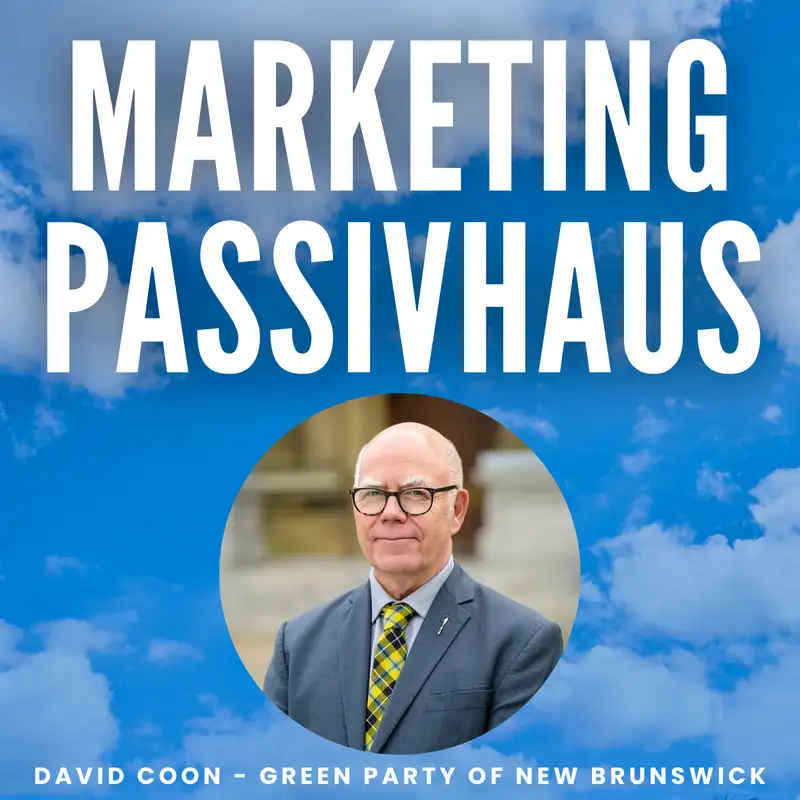
David Coon - Green Party of New Brunswick
44 - David Coon - Green Party of New Brunswick (edited to 7:50)
===
James: Hello, and welcome to Marketing Passive House, the podcast where we hear from architects, designers, builders, suppliers, owners, and other experts in the passive house and high-performance building space. We'll be talking about what's working and what's needed when it comes to marketing buildings that meet or aspire to the passive house standard.
James: I'm your host, James Turner, and today I'm joined by David Coon, four times elected member of the Legislative Assembly for Fredericton Lincoln and the leader of the Green Party of New Brunswick. David, welcome to the show.
David: Thank you very much. I'm happy to be here
James: This is great. I'm, I am very honored that you took the time to chat with me today.
James: So before we get too far into it, and for people who are just meeting you for the first time, could you share a little bit more about who you are, what you do, and how you started on your passive house journey?
David: Yeah let me go way back because I think that's it really creates the context. Um, When I was in high school, the environmental movement in Canada was just taking off just- rocketing forward with the establishment of the Conservation Council of New Brunswick based out of Fredericton as a provincial environmental advocacy group. The same year Pollution Probe was established in Ontario based out of Toronto and really the first two environmental advocacy groups established in Canada in response to the environmental crisis that had emerged and was emerging at the time. That was '69. I was in high school. in, in '72, the Club of Rome published the Limits to Growth report, which became a bestseller, looking at the fact that we live on a finite planet with limited resources and limited room to put the wastes we create when we use those resources. Being in, late teens and you wanna do something
James: Yeah
David: that. You wanna make a difference. And in, in '73 was the year I graduated high school, the Science Council of Canada published a, a report on natural resources policy issues where they first coined the phrase or the term conserver society, making the ki- the case for shifting away from high levels of consumption of resources, energy resources.
David: And that was followed by the first big oil crisis, the oil-- OPEC oil embargo led by Saudi Arabia in the fall of 1973. I had just gone into into CEGEP at that point living in Quebec.
David: And on the heels of that, there was a, a response, a tangible response in Canada with the construction of the Ark on PEI which was the New Alchemy Institute with the support of the federal government as, a- as they described it as a bio shelter kind of effort to make self-sufficient, energy-efficient, solar and food secure kind of shelter on PEI. And right after that, in 1977, the Saskatchewan Research Council unveiled the Saskatchewan Conservation House, which focused specifically on energy and really laid down and established the basic design principles for passive houses today as we know them and principles generally for energy-efficient housing. Harold Orr and Rob Dumont were two pioneers there. Harold was working for the Saskatchewan Research Council, and Rob Dumont w- at the, the beginning was at the University of Saskatchewan, then it moved over to the Research Council, and they became real so these folks, like the folks from the New Alchemy Institute John Todd and company and then i-in the Canadian con...
David: john wasn't Canadian, but Harold and Rob in the more Canadian cons-context bec- all became s-sort of heroes in the sense of doing something very concrete in response to these, the, the warnings of the limits to growth the insistence by the Science Council of Canada, we need to move towards a conserver society.
David: And it was that year when Saskatchewan Conservation House was opened up that the Science Council published its blueprint really for tackling environmental and resource con-constraints called Canada as a Conserver Society. so that that in- kind of inspired folks at the Conservation Council and folks at the Pollution Probe Foundation to try and pull some of those things together into existing homes.
David: The idea being, okay, this is something we can really concretely do to demonstrate how we can make a difference by tackling our housing s- existing housing stock in a way. The examples that were out there were all new construction. The ARC in, in the PEI, the S- the Saskatchewan Conservation House in Saskatchewan. So great ideas. What if we kind of weave, weave them together, knit them together, and apply them to existing housing stock? Conser- Conservation Council here created Conserver House out of a late 1800s frame building on St. John Street,
David: With the idea of Demonstrating those things l-local urban food production and high levels of energy efficiency and solar, passive solar gain and active solar energy and so on. And at the same time or a little before actually, Pollution Probe Foundation w-was doing the same with the creation of Ecology House which actually I ended up being the coordinator of and was there at the beginning of the guiding of the house and the design of what we were gonna do and the implementation of all of that. And so we were a, a small and mighty band of young 20-somethings who thought we could change the world through housing reform.
James: I love it
David: and the same thoughts were blossoming in other places. So as I said I was living in Toronto in the early '80s at the time after graduating from McGill and so gravitated towards that as something concrete to do, as all young people wanna do something that's very concrete to make a difference. and the same shortly after here at in New Brunswick at the Conservation Council with Conserver House. That happened in Saskatchewan a little later. Sorry, in Alberta, Alberta, a little later. And BC and Vancouver as well, and then finally in, in in Halifax with the Ecology Action Center. So these these ideas spread around around the, the country. All demonstration houses, all existing houses that were renovated and retrofitted. At Ecology House, we went a little further. We kept looking at... We used a composting toilet and treated our grey water and released the grey water into into one of our greenhouses and so on. And we had a t- also a big trombe wall on the south-facing brick. It was a brick building, so a brick to bring in heat, passive heat that way.
David: Th- that really is where I came from. The uh, Ecology House opened up to the public in October 1980, Conserver House I think a year later at in New Brunswick at the Conservation Council. And then both of them ran extensive programs educational programs, outreach programs, hands-on workshops to try and transfer some of these skills. When I was at Ecology House, we were t- running workshops on people's homes of how to do an exterior retrofit and, how to add a passive solar greenhouse and actually do it in place on some poor suspecting volunteer who offered up their homes for this. and then we'd have 30 or 40 people come out and work on, on, on get that work done and learn some of the skills involved. So that... And then I ended up at Conservation Council in 1984, a little on and off doing a little bit of work, but permanently in 1985. So that's where I come at this from.
David: But all of this occurred in an important political, economic and sort of cultural context, right? So
James: Right
David: You had the burgeoning environmental movement you had which was in a sense- Not new, but new for the, the generations of the 1950s and '60s people.
David: And you had a-as a result of that work, like the Limits of Growth, to Growth being published, the Science Council of Canada's work on conservative society as a way of responding to this and shifting our society to a conservative society. And McGill and University of Moncton Montreal, University of Montreal with funding from the federal government at the time publishing huge policy documents on three different scenarios of how you might get to a conservative society through efficient growth, low growth, steady state, and economy or voluntary simplicity which reflected that last and reflected the back-to-the-land movement that had been happening at the time. I-these, these created kind of a context. And the federal government at the time, the Science Council of Canada being an, an arm of the federal government and Pierre Trudeau was prime minister at the time, taking a very keen interest in this and making sure these initiatives were well-supported with respect to the Science Council's work and the policy work at McGill and so on, and the University of Montreal. S- and then in the nonprofit sector, the non-government side of things, civil society, what was happening with the environmental groups that were retrofitting homes and opening them up as educational centers and carrying and doing skills transfer workshops out of those. But that all and, it had an impact on building codes and policies.
David: So what happened in the Canadian context is we got the R-2000 housing programs and and New Brunswick, in fact, built more, proportionally more R-2000 than anywhere else in Canada. We took it on seriously. And then, we... we had neoliberalism just arrived. Smaller government, deregulation, so government's not involved in these kinds of things anymore. Deregulation the building codes will... Why would we impose a-anything major through building codes on people other than safety and fire, that kind of thing? I don't know safety issues. So things lost the momentum that was there and disappeared from disappeared, but became less of a front-of-mind issue for people from a policy perspective and and research institutions.
David: Although I will say the Saskatchewan Research Council continued to do its work refining energy efficient building practices, passive solar design through a whole series of build houses essentially right up until oh, the 2000s, I would say. When the passive house sort of reemerged, I wanna say reemerged because really the Saskatchewan Conservation House was its forerunner,
David: Reemerged back in Canada after taking off in, in in Germany. it was pretty exciting for me to see that happening and visiting a couple of the passive houses in Fredericton area,
David: Connecting with the builders who were doing that work and so on, and the re- and those who were trying to renovate in that, to that standard. But very, but it wasn't happening in the same kind of environment,
James: Right
David: back then. now we may be
James: On the verge.
David: we may
James: Yes
David: Be on the verge of that with this new oil shock
David: With the Iraq, Iran war, I should say. It's a couple of things. One is w-we're not anywhere nearly on, as dependent on oil at least in the housing sector as, as we were back in the in 1973.
David: Back then the oil prices spiked by 300%,
David: And the, the embargo was targeted specifically at only a handful of companies countries, Canada, Japan, the Netherlands, UK and US. so it was yeah, 300% increase between October of 1973 and March of 1974. You can imagine what kind of a shock that actually created. It got me thinking and a lot of other people thinking, but as a young person, I graduated from high school in '73, on to CEGEP in s-CEGEP in '74. So it was a, a heady time because there was this crisis clearly. Lineups in the United States for gas, and it was all over the media, front page, big screaming headlines and so on in that very rather short period of time. Upon which then followed these things and, Rob Dumont and Harold Orr said that they initiated the Saskatchewan Conservation House idea in response to that first oil crisis, the oil embargo of '73.
David: And in be- in, in, in the interim though, before they were able to open up and launch the building, the Trudeau had supported the the ARC in- PEI, which took it a step further not just beyond energy efficiency and passive design to look at food self-sufficiency in particular connected to shelter hence the bioshelter idea. Anyway the... There was, the kind of political con- and strong support from our own, from the government of Canada, when, through the Science Council of Canada they... It was very, very clear that the Cana- the prime minister was standing firmly behind this sort of shift or at least this interest in looking at this shift to a conserver society. And and we were seeing that representation in terms of what was happening with these, these housing demonstration, these demonstration homes, basically,
David: Really pushing the envelope on energy efficient design, passive solar use and with the arc food self-sufficiency. And then with Ecology House, we went also the next step to look at waste waste sewage and wastewater.
James: And do you think that the, for it to really move in Canada, it needs that national federal level support? Do you think that it's possible to do it in the new setting, the, after 20 years of neoliberalism?
David: I th-- so that's a good q-question. Yes I think so. But needs to be political will, which we don't have now that we had then. Right? And i-in fact, instead of the political will, we see things going backwards, with with Prime Minister Carney cutting the Green Homes Canada, or whatever that program was called which was resulting in a lot of retrofit work and a lot of solar electric installation, photovoltaic installation on homes.
David: There's numbers of bungalows in my own nei-modest neighborhood, Skyline Acres that took advantage of that. And it's, and then Carney went and canned it. And similarly they cut the o-oil to heat pump program they were running. And now provincially we see no real increase in our retrofit programs. And the commitment that the government made when it was running for government, the, what the Liberals made when they were running for government to institute a solar retrofit program and I think it was in their, pretty sure it was in their first throne speech they've publicly abandoned.
David: I asked the Minister of Energy about it in the beginning of the year at Public Accounts and he made it clear they'd abandoned that. Politically, things are moving in the wrong direction.
James: Right
David: It's all about not it's not about our demand or managing our demand in a way that's rooted in ethical approach to how we live in society and how society develops, but rather expanding production and fueling consumption.
David: So
David: We're in a very different place that way
James: Yeah. Yeah. I was talking... So I've had the the people from Passive House Massachusetts on the podcast, and Massachusetts is leading the charge, it seems, in this, in the US on getting Passive House into as, as a voluntary part of the building code. And I thought it was fascinating.
James: The guy w- A-Alexander is his name was talking about Passive House as a way of reducing peak demand. And in New Brunswick right now, we're, talking about building a gas plant to cover peak demand essentially. And I thought what if we reduced what the peak was instead of,"
David: and that was one of the
James: Yeah.
David: things for me and many others with the Saskatchewan Conservation House in, in 1977 was that, they said, "We can heat this house in Saskatchewan with essentially the output of a toaster."
David: And certainly when I visited the first passive house built in Fredericton essentially that's how they were heating the house as
James: Right.
David: With that kind of output, very comfortable in terms of any additional heat besides passive solar.
James: Yeah
David: I think exactly. So I used to write a, years ago when I was in my 20s, I don't know why they trusted me, but anyways, I wrote a regular housing column on energy and housing for The Globe and Mail. I remember one column suggesting that, not, just young and whatever, rash, but anyone who doesn't build to these kinds of standards is just stupid or something. I'm so much younger now than I was then. A- anyway it was, But the point is that it is, it's, it does seem like a no-brainer, right? If you can, if we can build homes and retrofit homes for that matter to the point where we're using very little ex- externally generated heat, then that, that's huge.
David: We're essentially minim-- like our demand is largely disappearing for energy production that way.
David: So which is why, for years, as in the context of the Green Party, we've been for a, a, a massive retrofit program with clear targets across the building stock to bring our...
David: 'cause, you can build all these new houses, but and we're not... we can build these new houses but the housing stock and most of the related to buildings is from existing houses that have been around for a long time.
James: Yeah
David: really need is a a major focus, a major program to re- with clear targets to, to retrofit our building stock,
David: Over time and increasing targets and all of that. But we haven't seen a government in Canada do that yet. so we did finally get an amendment to the Electricity Act requiring, NB Power to reach annual energy efficiency targets, but it's very in terms of their demand, but it's very conservative, let's say, easy to do. But other than that, yeah, we're not going there. and in fact, it was interesting, I was talking to someone in a building supply store recently and they were saying how the new building codes have gone too far,
David: Requiring external insulation around new builds to basically eliminate transmission of heat outside of, from the house to the outside through the studs by creating a thermal block,
James: Yeah
David: right? Not eliminating of course, but reducing it significantly. So y-you can see there's this... e-even those people in the building supply trade saying we've reached the point of diminishing trends or diminishing returns," so
David: They've gotten out of hand. So isn't that interesting,
James: That is interesting.
David: to hear that? It's, yeah, it's, and I would say also in, in the political world, which I've been in now for fourteen years since being elected leader, twelve years in the legislature is that right? Twelve years in, yeah. Housing is nowhere on the radar of house building and house renovations.
David: It's no long-- nowhere-- not-- never on the radar of governments as an important sector in our economy at all. I go to-- usually go to the New Brunswick Home Builders Association's annual awards night and so on, and, I'm the only politician there, and I go to a lot of events, and there's always ton-- many oth-other politicians at these kinds of events, but not that.
James: That's interesting
David: there's a weird... I don't quite what that's all about, but and when you see economic development strategies coming out of governments, doesn't matter which one we've had the housing sector's never reflected in it whatsoever. despite the fact that, New Brunswick Homeowners Association here has been really on the leading edge to try and move the needle net zero construction for example.
David: And so it is, even, eh, this is not exactly the same, but it's in the same church, not the same pew. But the Shediac pilot project that was done on community energy use w-with the National Resource Council and NB Power and and Siemens Canada which the CEO of Siemens Canada su- s-speaks about as being a model for how communities need to move across Canada to, look at establishing more self-generation with solar and demand flexibility, demand response systems, demand management with the smart grid and so on and so forth storage in the houses and whatnot.
David: It got no interest from the, any of the government's mem-members provincially except for the member, mem- MLA for that area, who's the former mayor who was there when they got it going originally. And he I know he's very frustrated that his government's not embracing this and saying, "Oh, this multi-year project really shows the way for how we need to move communities from an energy perspective and our electricity system, in a sense, on the demand side and distribute a generation side forward."
David: Just ignored. Ignored. So there is this. I don't I don't really understand why the housing sector is treated so poorly or ignored so much all. That is my, what I've come to understand n-now being in politics for the last decade or so.
James: It's very disheartening and odd. It's it's hard to get my head around ignoring... we all, those of us who are fortunate enough to have somewhere to call home are in it every day. It seems like such a, an obvious thing that affects everyone.
David: Yes,
James: even more than cars, although cars are right up there with it.
James: But as far as
David: And anything that's gonna do to, to give people a greater sense of security and wellbeing in their homes something that's gonna be politically very popular.
James: Yeah
David: so it-- I mean, I had great hopes for when Bernard no yeah, Bernard Lord created Efficiency New Brunswick,
David: As kind of the first efficiency, independent efficiency agency in Canada,
David: Which is what Efficiency One in Nova Scotia was modeled after originally. Some people may re- anyway s- but, that was end up getting folded into NB Power and losing the, its mojo as a result in terms of really being visionary and pushing the envelope energy efficiency and conservation. Yeah, it's I've talked myself into a corner now, but but
James: That does happen
David: those are especially it's common for me.
David: But th- those are some observations anyways I wanted to share with your listeners.
James: I appreciate that. Yeah. It's really, it's nice to hear the sort of I don't wanna say other side 'cause I don't see you as being the other... you're very much on the building and the other side for the majority of your story. It's just now that you're in government, you're seeing, oh, you're seeing the other side.
James: But it's really interesting to hear that reflected back. And so part of my thought w- in talking was like, I was gonna ask you things like, "How can we change the building code?" But if the, if they're, if that's not the way because they're already saying it's too much, like that, that's an interesting
David: The building code is moving along. It's just here in New Brunswick, we're very slow compared to many other provinces in terms of adopting the energy measures when they're renewed and improved every time in the building code. But, one of the things I remember speaking to a builder of Passive House at Fredericton About, how do we move this out of the niche,
David: And into more of the mainstream?
David: And he said we, what be really helpful is if the government put some R&D money into developing a prefab wall system for passive houses." So it would tr-tremendously reduce the labor involved in in, in kind of the double wall system. And that, that would bring the cost down significantly and and would really advance the uptake of passive houses.
David: So but to my point of there being no interest really in the housing sector from a political perspective that's... That wasn't gonna happen. Clearly it didn't happen. Unfortunately we can't... in the commercial building sector, we don't even have any interest on the part of government to do some R&D around mass mass wood construction commercial buildings, which, we're a forest-based province. Do you wonder, what were we thinking? And the major producer of mass wood pro- structural material is BC. And in fact, the New Brunswick or the Performing Arts Centre here in Fredericton was supposed to be, have a significant com-component of mass wood construction to it. But but they couldn't get what they needed out of British Columbia, and we don't make it here.
James: Right
David: that part of the design. Anyway that's a bit of an offshoot, but just to underline the lack of political interest in building construction, housing construction and that contributes to the economy, what it could contribute to the economy, what it can do environmentally, what it can do socially in terms of things like universal design and all kinds of things.
David: It's where we live, as you said, so it touches us in so many ways. And that, that's, Yeah. That-- For me, that's just fr-frustrating. And I don't know, what the kind of things that, that would change it are the perfect storm that happened in the 1970s, I guess between s- between public demand coming out of the environmental crisis that was emerging and government leadership between institutions like the Science Council of Canada and the Saskatchewan Research Council and at the political level with Trudeau and some of his cabinet members and caucus members and the Premier of Prince Edward Island in particular, who was a strong supporter of the ARC and,
David: Right over there. So y- we... Maybe we're heading in that direction again. It's not gonna be a repetition, but maybe the conditions are gonna be such that,
David: W- we'll reach that, that moment once again where maybe we'll see another big step forward. I hope so
James: I suppose, yeah. It's, it didn't I guess it's hard too for people who are thinking like, "Hey, we can do this proactively. We can sort this out before there's the next crisis." But I guess for things to move at a big scale, it's usually reactionary
David: Well, can you imagine the ecological economists, like what they're feeling? Peter
James: Yes
David: Peter Victor, one of the better-known ecological economists in Canada who's up there with the others around the world i-in terms of international recognition, he wrote a book called something like, this isn't exactly it, but Changed by Design, Not by Disaster,
David: To your point,
James: Yeah
David: And that really was... That, that was really the whole effort that was be- or the whole impetus behind what the Science Council did in the 1970s. I think what Trudeau was seeing himself
David: Pierre Trudeau for pushing that and and the work of the what they called the Gamma Group, the collaboration between, City de Montréal and McGill on, on how you actually implement all this.
David: Here's the policy proposals for these three different possible scenarios. Yeah, I guess I I, I get stuck on sometimes a little bit too much on, we've gone through this before and whe- we I shouldn't think we're we we need to, yeah I'll just say I think that moment is coming again, and it'll be different, but it's gonna open some doors to, I hope, bring a positive change.
David: But I will say one of the differences is time and is there are Green Parties in Canada. There are Green Parties around the world, but there are Green Parties and Green Party-led MLAs and MPs in the legislature in the House of Commons. The PEI Greens are in the polls the top choice for government in, in PEI right now. The
James: That's cool. The UK, yeah
David: And why did this happen? Because why are there green politicians? Because when things started to go south in the '80s and '90s when things really started to back off, particularly in the '90s from from really thinking about how do we make a, a more ecologically sustainable society, community, neighborhood, home at every level that drove some of us to get into politics and so here we are. And and so maybe the, that political moment is coming and certainly it looks like it's happening in PEI, which would be fantastic. We'll see what happens here in New Brunswick. But I would say that like New Brunswick and PEI who tend to elect more green seats than anyone else does on a provincial basis, and, and states like Maine and Vermont,
David: There's a greater sense in the culture of independence and being self-sufficient which is ready-made the space and new mo- new momentum to go forward. 'Cause if there's one thing New Brunswickers are, it's independently minded,
David: And have this ethos of really wanting to be as self-sufficient as possible and not not be reliant on others. I was at
James: Definitely
David: meeting of the Agricultural Alliance in New Brunswick, so one, one of the two general farm organizations.
David: Many, particularly dairy farmers, are building solar farms on their farms, harvesting the sun as it were, and but they're capped at 100 kilowatts. So in terms of the capacity of the system, they c- and wanna produce more and put it on the grid to share with others and generate some additional revenue for their farms. Nova Scotia, cap is two thousand kilowatts.
David: So there's a good push coming from the farming community to get that cap changed here 'cause they've seen what solar does for them, for their bottom line and for their own sense of their contribution to the future
James: Yeah. Yeah
David: So that's great,
David: But for some reason once again the, the political narrative is going in a, in, in this opposite direction. And maybe it's the last gasp of the fossil fuel industry that's helping to drive this. but it is in our face, that's for sure
James: Yeah. These are, huh, a lot to think about. This is meaty stuff, and really
David: have any hair left Sorry, I
James: I feel like
David: t-
James: it's an audio... Yeah. We'll I'll make sure I put a picture.
David: can imagine, yeah. It's like dad jokes. I shouldn't tell bald jokes anyway and I'm both, so
James: Excellent. Thank you so much for taking the time to chat with me today and
David: been fun. Thanks for putting up with me. I really appreciate the opportunity to share some thoughts in this way with with your listeners and that's exciting. I'm
James: Excellent
David: will resonate for-- with some and will be new to others. And I hope your younger listeners will be inspired
James: I hope so too. Thank you. Before we go where... If you were gonna direct someone online to either find out more about you or your work or work that you think is important do you have any
David: Oh
James: I'll link to them in the show notes, but then this will be on record
David: in terms of what I do day in and day out as an elected Green MLA going to our caucus Facebook or website, and my Facebook page would be the best. So I, I-- if you just Google David Coon, it comes up. I forget what the actual URL is, something about Green Caucus,
James: That's fine.
David: there.
James: find it and put it in.
David: yeah and that's pretty good at making sure people are-- have a window into the day-to-day work here and over time at the legislature and in, in the riding, in my, in, in my riding, which is Fredericton, south in Lincoln, which is now part of Oromocto. That would be best.
David: There's, of course, the Green Party's on all channels in all provinces and nationally socially, social channels, so there's those. But but in terms of the actual work and the bills we bring forward and, I bring myself and my colleague and have brought forward, I think some pretty interesting legislation or bills, proposed legislation over, over time. And a few things have made it through. Others have helped influence legislation the government itself brought forward in a positive way, and some just the most important ones, I think, have just got roundly defeated. Like our recent bill to create a right to a healthy environment for New Brunswickers.
James: Yep
David: but or some bills I've introduced that mirror what's already in place in Nova Scotia to drive particularly to drive solar and community renewable energy development, also have been roundly defeated.
David: So go figure.
James: Yep. Very good.
David: All right. Nice talking with you.
James: Yes, thank you so much.
David: Take care.
James: You've been listening to Marketing Passive House. I'm James Turner, and I hope you'll join me again next time.