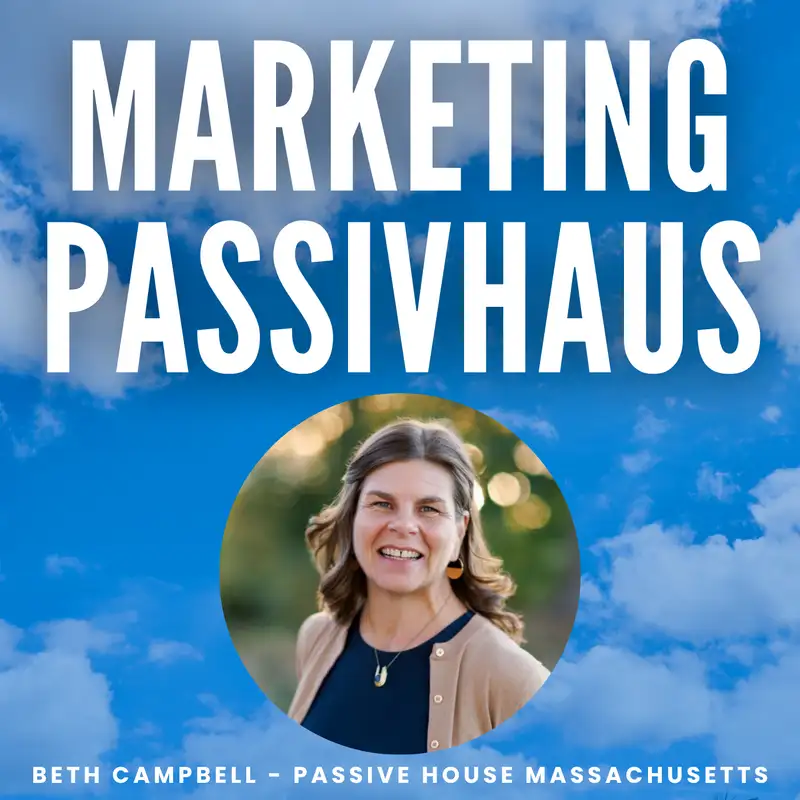
Beth Campbell - Passive House Massachusetts
34 - Beth Campbell - Passive House Massachusetts
===
James: Hello, and welcome to Marketing Passive House, the podcast where we hear from architects, designers, builders, suppliers, owners, and other experts in the Passive House and high-performance building space. talking about what's working and what's needed when it comes to marketing buildings that meet or aspire to the Passive House standard. I am your host, James Turner, and today I'm joined by Beth Campbell, education program director at Passive House Massachusetts, Certified Passive House Tradesperson, PHIUS-certified Passive House builder trainer, and the chair of the board at Passive House Rhode Island. welcome to the show.
Beth: Yeah, thanks so much, James. Great to be here
James: Thanks. So before we get into it, and for people who are just meeting you for the first time, could you share a little bit about who you are, what you do, and how you started on your passive house journey?
Beth: Yes, you just said a mouthful about all the various passive house yeah, things that I have going on in my life. And it's true that I have been really excited about passive house and passive building since the moment I heard about it. And so as you mentioned, I'm working in Massachusetts, though I live in Rhode Island, so I'm working on passive house initiatives in both states.
Beth: Professionally, I'm working in Massachusetts right now. We're supporting... as listeners may know, Massachusetts is at the forefront of passive building especially with a lot of state incentives that have come through of the, over the past years, which has really encouraged a passive building boom in the state especially in m- multifamily construction, where in about a third of the state it's now code if you're building a building 12,000 square feet and up to build it to passive house standards.
Beth: And when I say about a third of the state, it's about a third of the, where the population is in the state, so
Beth: Significant.
James: Yes
Beth: and then living in Rhode Island, we have a different set of constraints and industry interests here, and we are more of a networking group to help folks who are interested in doing high-performance construction, building better than code, to be able to find each other and network that way.
Beth: And then, yeah, I do wear a hat as a contractor for Phius teaching one of their certification courses to builders as well. So that's pretty that, that sums up where I am right now. My, my past is I've been a builder for over 20 years, going on, I don't know, 22, 23 years. I started out in the industry, as I say, with tool bags on, so working as a subcontractor, working primarily in single family construction.
Beth: And my initial foray into green building, if you will, was actually through natural building. So I was doing work with folks who were building straw bale homes or other types of very low carbon homes. And then that led me up until my first introduction to Passive House, which was in about 2014.
Beth: I read an article that I've never been able to find again but it piqued my interest. It was about a small single family passive house that was built. It was built somewhere in the Midwest, and I was like: Oh my gosh, what is this? And at that point I was moving to Portland, Oregon, and looked up the local Passive House group there, that's Passive House Northwest.
Beth: And I ended up sitting on the Passive House Northwest board for about six years as well. And at that point I basically just never looked back because it made so much sense. So that's, yeah, a little bit about my background.
James: I love it. And hooray for the straw. I also, I have a deep love of bio-based building, and I think if I were gonna do something for me, I'd try to find a way to make a passive house straw bale.
James: But did you
Beth: Funny enough, I w- I was just, I was really into kind of what the industry called green building at that point, and that was the only-- that was all I knew. And what I really loved about Passive House was when I when that came into field, was the focus on operational energy and operational carbon.
Beth: Because up until then, I had just been focused on materials, and the opportunity to really focus on reducing the carbon impact of buildings through specifically the lens of energy efficiency, really I did a 180. And it was funny that it was really about five or six years later that the industry has now that we've, squashed our operational energy loads and that the industry is understanding that, and a lot of states are adopting energy code that helps to really bring down those operational energy loads.
Beth: Now the focus has turned again to materials, back to materials. So it's funny
James: Nice.
Beth: yeah, that trajectory.
James: I like that. That's an interesting thing too. I feel like that's a progression of knowledge where you focus on inputs and then focus on outputs, and then l- like you measure things, the other side. I don't know,
Beth: Right
James: You, you track or lagging indicators that sort of...
James: it feels like, it feels connected. It all feels connected i-
James: in a way.
James: And for me I was dabbling with, not seriously, but just informationally with earthships passive house first came my way. But earthships what me talking to people about, "Oh, there's different ways to build besides just the regular kind."
James: And that... If I hadn't done that, I don't think I would've had someone then say, "Have you heard of passive house?" And
Beth: Yeah. Yeah. I think that some of those different types of really alternative buildings that are out there that are using really kind of rudimentary materials like mud,
Beth: Straw, I think are interesting and they can capture people's attention as an entryway in.
James: Yeah
Beth: But yeah, for me, again it's less about materials and more about how do we leverage better construction practices, both not only from an environmental perspective, which, frankly is what got me into it originally.
Beth: But for a lot of people, when we're thinking about widespread adoption of Passive House, it has nothing to do with, whether or not you like straw or whether or not you like steel. It has much more to do with what are the implications for human health, for building durability, for the grid, for looking at how we build better buildings that support the inhabitants of those buildings.
Beth: As we're looking at, climate change, there's a lot of bizarre things that are happening, deep freezes, heat waves, wildfires. Passive House also does an excellent job with any of those as well. I really applaud the Passive House industry and movement from getting away from just being lumped in with the tree huggers and really addressing addressing some of these other issues that, that, you know, building-- Our built environment, frankly is not amazing, and Passive House offers solutions in many ways that can get us away from those bad building practices that we've had for so long.
James: Well said. And yes, I like-- That's a really good point about... Like it's-- I find it satisfies all these different
James: things. You could have your horse in many different races, and if it's a passive house horse, it'll come out ahead.
Beth: Yeah.
Beth: Yeah.
James: analogy,
James: but
Beth: but I do find, I know that the topic of this podcast specifically is marketing Passive House, and I think that where we've seen Passive House as a concept really be able to take off in the industry is the way that Passive House does an excellent job of addressing some of these other concerns: durability, resilience, health, indoor air quality, which of course no one saw coming in 2020, but has, become one of the forefront boons of Passive House construction with excellent fresh air delivery systems.
Beth: And then, yeah, a- and also looking at cost. A lot of people talk about the upfront cost of Passive House, but we like to really focus on the long-term cost savings of building buildings that are more efficient and looking at if we're-- if we truly are building an excellent building, which is probably gonna be around for 100 years, if not more, what are the cost savings just from the utilities perspective, and how much how much more that saves versus any upfront costs that, that might be there to, to build a better building in the first place.
James: Absolutely. Yeah, and I've talked to f- several people now who've said that at the scale too, it's, it, th-there isn't even really an upfront cost
Beth: Yeah. And I don't want, I don't want to promote the concept that there is not an upfront cost. It depends completely on the team, frankly. I have heard of projects where there is not, there's not a premium to building to Passive House, but I think most of the industry experiences some premium.
Beth: Whether you're working on a multifamily building, a commercial building, or a single-family building, there's probably going to be something there that might cost the project more. But generally speaking, that's a pretty small percentage of the overall budget, again, depending on building type. If you think about it, Passive House has really taken off in the multifamily space because if you're looking at a large apartment building a lot of the Passive House additional costs may come with the building enclosure.
Beth: And proportionally, if you have an apartment that only has one exterior wall, all other five sides of that box are interior, right? Then just the proportion of building out that space versus the exterior component is a smaller proportion of the overall build budget, if that makes sense. So
James: yeah
Beth: yeah.
Beth: So that's where we've really seen it taking off and making sense financially.
James: And so have you found that a benefit then to reaching out to the develop-- I assume that the people making those would be termed as developers.
Beth: Yeah.
James: that how you
Beth: I think so. Yeah. Yeah. Yeah. The industry, yep
James: an outreach to developers specific in your programming at all, or?
Beth: Yes. Massachusetts we're in a rare place coming in Massachusetts right now because as I mentioned Massachusetts has code in place that either encourages or in some cases requires Passive House delivery, depending on where you are in Massachusetts, also what type of building you're building and how large it is.
Beth: For the areas that-- and the building types that are not required to go the Passive House route it's definitely on the table as one of the options because Massachusetts in general has a pretty significant energy code. So it's like you can meet that code requirement via multiple pathways.
Beth: Passive House is one of those options. And because Passive House is a very well-developed program with a lot of support and in Massachusetts there's a lot of incentive support as well, then it becomes a no-brainer for a lot of those developers to go that way. In terms of your question specifically, is there outreach?
Beth: Absolutely. Like we're working really hard to make sure that anybody interested in building Passive House has the information that they need to decide whether that's the correct pathway for the building that they're doing. We've seen In Massachusetts, we've seen primarily multifamily buildings getting built in the affordable sector because those affordable developers tend to hold the project over a long period of time, and therefore they're able to really take advantage of the cost-saving opportunities through those operational savings through the utilities
Beth: They're the manager of that building over a long period.
Beth: And what we're seeing, hot on the heels of affordable now is market rate multifamily building. And, I think that's a really interesting topic. I haven't had I haven't had a ton of conversations with market rate developers, but there's some really interesting avenues that they're taking to make sure that Passive House, because it's gonna be in a lot of cases more expensive and therefore they don't want to have to charge charge more for their apartments that they're building, right?
Beth: So how do they market, just again, to the name of your podcast, how do they market those apartments so that they are more interesting to an average person who's just looking for an
James: Right
Beth: apartment to live in, right? So what are the benefits that, that they can name of why somebody might pay slightly more for an apartment in one of those buildings? So it might come down to utility sharing, like lower lower operational costs. It might be a more comfortable place. It might be based on air quality.
Beth: It might be actually larger windows that they have because they're putting in really excellent windows, therefore they can get away with with basically a larger window-to-wall ratio. So that's something that people want is a lot of natural light in their buildings. So there's a lot of different opportunities to market Passive House when you don't have these subsidies in place.
James: Absolutely. And also underlying that is mark-- a term that's come up again and again is mark- the best way to market Passive House is to not put the word in there, right? That's something that has
Beth: We don't need to confuse people. We can just say,
Beth: "Hey, do you wanna live in a healthy building?" "Yes." "Do you wanna live in a building with good air quality?" "Yes." "Do you wanna-- Are you in an urban environment and you want your apartment to be quiet?" "Yes." "Okay, great. We'll give you all of those things,"
James: That's
James: right, yeah. And I could see that too, like maybe the developers would be... they would be able, like they'd be knowing about Passive House 'cause they'd be looking at the code and deciding which path to take, like you were saying. But then, yeah the renters. Some, obviously there's a growing, there will be a growing number of people who would jump at the chance to rent a Passive House apartment.
James: But I'm sure that's not a financially, lucrative market to chase just yet,
Beth: Yeah. And I think, I, and I think they're figuring it out, which is great. So that b- by the time it is more widespread just outside of Massachusetts or some other pockets like Seattle, where we've seen some of those multifamily passive house buildings come online,
Beth: They're figuring out, exactly how to mark...
Beth: 'Cause, because you're, what you're speaking to is true. It's marketing passive house not only to the developers, right? So who have to invest it and fund it initially, but then also to your renters, right? So there's multiple layers of how do we get the word out about these being better buildings.
James: Yeah. Which is I think, and I think that's really interesting too, because there's these different pathways to find out about it or find the kinds of people that'd be interested in it.
Beth: Right And, to speak to how do we market i-in terms of thinking about all the different players that are happening in, So it's not just developers, it's not just renters, right? We also have architects and builders, obviously. And within builders, we can talk about GCs and we can talk about subcontractors.
Beth: So we just have, thousands of companies in Massachusetts alone who are now considering, "Why are we building to the Passive House standard?" And and how do we build to the Passive House standard, right? Too, because there's certainly an educational learning curve that's happening with, Massachusetts, New York.
Beth: We're seeing a bunch in New England happening right now, where all of a sudden there's so many of these projects getting built. It's not just the seasoned Passive House builders or architects. We're now seeing a lot more people come in who are attempting to work on their first passive building.
Beth: And,
James: Very cool
Beth: yeah, and interestingly, Passive House Massachusetts has a generous grant from Massachusetts Clean Energy Center right now to develop curriculum to help these teams get up to speed, right? And so a lot of what I'm doing is developing curriculum to help, very targeted trainings for particular roles in the industry.
Beth: So if you're an architect, you need to know, this set of things. If you are a an electrician working on a Passive House, you might need to know this set of things, and, for everywhere in between. And as part of the implementation of this curriculum, we first undertook some significant research last year.
Beth: I interviewed 40 different Passive House practitioners and asked them about, who needed education, what they needed to know, what were the s- the stumbling points in the projects that they've been working on, and what are some of the best practices, what are the best of the best practices that they see that they've been implementing in their projects.
Beth: And we compiled the research and so these 40 practitioners collectively had worked on 20 certified Passive Houses, but had also been representing over 100 different projects, most of them multifamily. So really a huge wealth of information, and we put this together we published a white paper essentially that's available on our website.
Beth: You can probably link it when you put this out, but it's phmass.org. And in this report, it's just chock-a-block full of best practices and ideas for teams who are new to Passive House delivery to save teams, the headache and the pain and the money Of not having to make the same mistakes that some of these pioneering teams have made.
Beth: And there are plenty, right?
James: Yeah. Yeah
Beth: But as we get better at this as an industry and as we have subcontractors that, say, have already worked on one project and now they're working on their second or more, we see the whole industry coming up with this base of information. Yeah there's a lot to learn, but there's a lot we already have learned as well.
James: That's great. And I've-- I think one thing that I've loved during my time in the Passive House community is just how willing to share experience and knowledge everyone seems to be. I haven't met a single person that didn't want to
James: help
Beth: Yeah.
James: else do
Beth: Even, in companies that are yeah, technically they're competing with each other, they're still absolutely willing to share these best practices because I think unlike other other arenas, in this very what has been niche market, which is much more coming mainstream right now, passive building, we've needed each other.
Beth: We've needed to be able to learn from each other as colleagues and support each other in this work, and that has been the culture of this, Passive House movement, if you could call it that. And I think that there's a collective spirit of, with the rising tide, all boats float, and that really by, by sharing this hard, these hard-won lessons, it's only gonna benefit us in the end the better that we all do.
Beth: So I agree with you. Absolutely. It's been it's been one of the best things I think about working in this field is that collaboration piece.
James: Yeah. What a difference it
James: makes when people pull together to help everyone have a better life,
James: Do better.
Beth: Yeah
James: one particular to zoom right into something that I've found really interesting and I've seen a couple of times, and it's probably part of what you were talking about, is the kind of on-site signage.
James: "This is a passive house. Don't drill a hole here." Or like a kind of like a helpful, partially a warning, but also I think it's just like helping people understand the specialness of where they are when they're on the site and
Beth: R-right. Because some of the, a lot of the techniques that, that Passive House employs in order to build these better buildings are not that complicated, but you do have to pay better attention. And what you're alluding to right now is the air tightness factor. These buildings are extremely airtight.
Beth: You can think about it as like an insulated thermos, right? That's a really good analogy for the enclosure. If you have a Yeti thermos that, boiling water, your coffee in there is gonna stay hot for hours and hours. And it's not crazy technology. It's airtight and it's well-insulated, right?
Beth: And then humans, of course, can't live inside of a Yeti. We need fresh air. So then on top of that Yeti thermos, you put in a fresh air system with filtered regular air, right? So to me, that's a clear analogy for how we build a better building. So in terms of what we're seeing for communicating this type of very basic information, as you say, something as simple as like a sign on site saying, "This is an airtight building. If you make a hole, either fix it or tell somebody," that's like a basic level of information that folks need that they don't always have.
Beth: And so that's part of my job and my role right now is getting the message out. How do we most effectively get the message out of the basics? Maybe a trade person doesn't care to or doesn't need to go to a full week's certification course in Passive House delivery. Maybe what they need is 15 minutes of targeted information that will help them do their job a little bit better in regards to Passive House.
Beth: The trades are coming in with a ton of knowledge, so we just need to leverage that and focus it to make sure that they understand what's the same and what's just maybe a little bit different about what we're asking you to do on this project. But it doesn't take a lot to get folks up to speed with where they need to be able to be effective practitioners.
James: Yeah. Nice. And think that's such a kindness too. letting people know... I don't know. I, it makes me think of wayfinding. If you land, come out of an air- an airport a plane in a foreign city, and the city's where it's really easy to tell what to do
James: It's just clear, the train is this way and the bus is that way, and the parking's that way, and what- whatever it is.
James: But I find it's such a... I think of that as all being an act of marketing. I don't know if, I don't know if I broaden the term marketing too much, but it's spreading the idea in a way that like, makes it feel good to receive it. If
Beth: And I think
James: in something and you didn't know that there's a thing that just tell someone or fix it, try and hide it or just,
Beth: ex- exactly. Or you just don't, you don't, you just don't think about it 'cause it's not a big deal on your other projects. And I think that you're hitting at something that's really key. And o- one of the largest takeaways from our entire research body was the, one of the best indicators of project success is buy-in.
Beth: So if we have buy-in from the trades, if we have buy-in at every level, from the GC, from the architect, from the developer, we have a much better chance of hitting project success. And the, one of the ways that we get buy-in is we say, "Okay we understand you have a ton of experience in your trade.
Beth: Please help us understand, come up with creative ways that what we're suggesting that you could do better." Maybe you have an idea about sequencing. Maybe you're coming to the table with more ideas about materials, something like that. So that's just from the trades. But across the board buy-in.
Beth: Yeah. A developer, you understand the financial implications in the financial world so much better. You're gonna have ideas about how you can bring in your previous knowledge around how to put a deal together that can make this project succeed. So on, on every level, if we have that buy-in, then we have people coming together on that project team who are collaborative, with a can-do attitude, and who are naturally going to be inclined to problem solve instead of finger point is one of the biggest takeaways from, from all this research.
James: Amazing. respect,
Beth: Yes. Yeah. Starting with respect. Absolutely. Yeah. Yeah. Giving everybody, everybody has a voice that comes in that has a lot of background and history and experience, and so really seeing that as an asset to the project.
James: Nice. I don't know if you agree that would fall under marketing, but I feel like in-
Beth: Yeah.
James: Marketing or,
Beth: yeah, exactly. Yeah we've been calling it buy-in. You can call it internal marketing. But basically if you're showing up on a job and you don't understand why you're being asked to do this annoying thing
James: Yes
Beth: You're not gonna d- you're not gonna do a complete job of it.
Beth: But if you understand that you're connected to the fact that your grandmother lives in a, some type of low-income housing development, and she's got really bad air quality, and you can keep her in mind because you wish that she had a, better air quality, she didn't have to smell the exhaust from the street or listen to all the traffic below, something like that.
Beth: If you have a personal connection to why Passive House is important, then it's gonna make you much better at your job. That goes for all of us, right? If we're connected to the why, then we'll be more motivated to, to perform better.
James: Nice. I'm so glad. I'm so glad that the research bore that out too. That,
Beth: Yeah.
James: you know...
James: I didn't-- I intuitively c- believe that it wouldn't, but it's always nice when things align like that, right?
Beth: Yeah, and the research, of course, there's still some other stuff too that's that's more targeted make sure that your ductwork is well sealed. A little more nuts and bolts.
James: Yeah
Beth: There's something for everybody in this research that we put out.
James: Excellent. and so on a more personal level this is something I always try to find out. When you're talking about what you do to people who aren't in the Passive House world and if you're ever out of it, although it sounds like you're almost
James: entirely in
Beth: in it.
James: So
James: if you can...
Beth: I should leave my comfort zone sometimes.
James: I always just am curious to know, and maybe your thermos analogy is so good that there's nothing better, but like just if you have any anecdotes or memories from conversations where you've f- from cold introduced someone to the concept and
James: what
Beth: I think I, I've got an u- I've, I have an uncle who's an architect, and he's a conventional architect. He's now retired, but he did a lot of single family home and b- beautiful homes, absolutely stunning custom architecture. And sometimes I think about okay, how do I talk to somebody like that who is excellent at what they do?
Beth: They want to provide a really good home for their clients, and it's you've got some clients with some money. Do they wanna live in a place that's comfortable, where they can walk around barefoot in the winter and not feel chilled? Or They can sit next to the window in winter and read their book and not feel chilled, right? So there's a lot of opportunities when we talk about the benefits of Passive House that are not esoteric. They're very grounded and very real. Like we can talk about, do you wanna sleep better because you're gonna have less CO2 buildup in your bedroom at night because you have a fresh air delivery system.
Beth: Do you want a clearer head in the morning? Yes. Who's gonna say no to that,
James: yeah
Beth: And so in those conversations, I think about the benefits. There's so much to offer there that those conversations I think can steer away from like why we should be doing this to more like why wouldn't you do this, right?
Beth: And then and then, I think the other set of conversations that, that is had quite frequently when we talk about Passive House is the cost implication.
James: Yeah
Beth: again when having those conversations with somebody who's maybe dubious about is it worth it to spend the extra money up front or to go through the extra hassle of certification, something like that, right?
Beth: As a builder over the last 20, almost 25 years, I have seen that... and, I m- I moved into project management at some point, right? For, 13 years I was project manager on buildings. And The buildings where we were either certifying them under a certain certification, whether or not it was Passive House, maybe it was Energy Star, maybe it was Zero Energy Ready Homes, something, some other certification where we had a third party coming in.
Beth: That third party inspector caught so many things that were not even related to the standard that they were supposed to be inspecting, right? A certain, wall cavity was missing in- insulation entirely, or there was a hole left that nobody caught and cold air was just blowing into the house that would've been covered up and nobody would have ever noticed that.
Beth: Or like a duct in an attic was squished 'cause somebody was up there and stepped on it, and when we, tested the duct pressure, it was all off. And it's oh, this person would've moved into this house or apartment and paid through the, through the roof for these oversights.
Beth: But because we had somebody there checking it, it made a better building irregardless of the standard. So number one I think having another person there outside of just maybe the jurisdictional inspector who don't-- they're not always charged with actually coming in and doing a thorough inspection, right?
Beth: So that's one of the things that we're talking about is a Passive House standard ensures a much more thorough inspection. So the cost is to, to that person is also durability of the building. Making sure that proper things are installed as designed so that the durability of the building over the long term, and you don't have callbacks as a builder, right?
Beth: You don't have warranty claims as, as commonly 'cause you fix these, you find these issues, and then you fix them. And then another question I think where we get pushback is about the upfront costs of the additional dollars that might be spent. And again, we need to start thinking more holistically about our buildings and that even if there's a certain percentage that we would save by not doing a high-performance building That the cost to society for the individual homeowner, apartment renter, whomever it is, school, the community that's paying for that building for the utilities, but also the impact of higher energy usage on the grid.
Beth: So one thing that we like to say is that you can either spend, billions improving the whole building stock, or you can spend trillions upgrading the grid. And if, if the amount that we'd be spending on making better buildings also comes along with health, indoor air quality, comfort, resilience, all of these other benefits, it is such a no-brainer
James: On every level.
Beth: On every level.
James: I thought of two things w- that there's a saying with health "If you don't make time for health now, you better make time for sickness later."
Beth: Yeah, right
James: it feels like analogous to this, right? You spend a little bit of extra time making things right, but then you won't have to
Beth: Yeah.
Beth: Yeah. And yeah, and
James: in five
Beth: so, yeah, so either we pay a little bit more upfront for our buildings or our, let's just say our utility rate payers are gonna be spending more and more every year as we build more infrastructure for energy, instead of just investing that upfront.
James: And another thing that I thought of as a homeowner, we bought a house from the '50s. And every time something has gone wonky and we've had a tradesperson in almost every time they've raised their eyebrow at the way it was done, right? There's th- there's this sort of now, maybe that's a, maybe that's a tactic to charge more. I don't know. But th- there's there's this feeling of "Oh, why didn't they just do it right in the
James: first place?"
Beth: Yeah.
James: not put a
Beth: And
James: in this... in our case, there was a downstairs duct that they like just cut a hole out to make air go into downstairs, and then the upstairs was freezing because the air was all com- the hot air was all coming out.
Beth: Absolutely.
James: That kind of
Beth: Let's, refocus on high quality construction from the offset. And I've been talking a lot about new construction, but this has to, apply also to remodels. Absolutely. I live in a 1940 house. I've been working really hard to get this house even just like for me, it's not about do I save $10 on my electric bill, right?
Beth: But it is about can I work in my home office comfortably without freezing, right? How many layers do I have to wear? And this house is not a passive house nor will it ever be. But what can we do as homeowners to to improve our living conditions? Absolutely.
James: Nice. Yeah, I purposely in the intro to this podcast put in meet or aspire to
Beth: Yeah.
James: House standard
James: 'cause I,
James: I think that's important, right? It's like you're, yeah, aiming in that direction is
James: also worthy. Funny
Beth: sh- and should we ever, and should we ever go through a major remodel where we replace the siding or something like that, then you can do these kind of step-by-step retrofits that might be over a period of time. But, somebody had already replaced the windows, so what's the carbon impact of tearing out new vinyl windows and putting in different vinyl windows, that are better?
Beth: But what's the carbon payback on that? It's not enough to warrant it. But you can, you can take step-by-step action as a long-term homeown- homeowner to, to make some of these improvements in phases. A phased approach,
James: with comfort too. That's very
Beth: Yeah.
James: You know the things that you don't like about your own house.
James: The
Beth: And our, gas bill, was cut in half just by some very basic air sealing and insulation that we did in the house.
James: Nice.
Beth: Yeah
James: my funny side note that I was gonna say is that, so I'm recording this in my home studio and home office. It's in the basement, and I have to turn the heat the space heater off to do the episodes because it would be this loud fan going on. And so
James: we're talking about the benefits of passive houses, the radiant
Beth: Quiet.
James: drops
Beth: yeah
James: The windows are, like, sucking the heat out of my body, and
James: yeah. I very much the ah, it'd be so nice to have those windows that you can sit next to on a cold day, and
Beth: Yeah. I dream of those too. Being in this industry, like I have aspirations as a homeowner as well. Not quite there yet, but
James: Yeah.
Beth: we'll get there
James: Look this has been great. Thank you so much. We go, where is a good place for people to go online to find out more about you?
Beth: Great. You can find Passive House Massachusetts at phmass.org.
Beth: You can find Passive House Rhode Island at passivhausri.org, and you can find me on LinkedIn my LinkedIn handle is Beth-Campbell-BetterBuildings. You can probably find me that way. I'd love to connect
James: Awesome. Okay. I'll definitely include all of those in the show notes. yeah. Thanks so much for joining me today
Beth: Thanks so much, James. It was a pleasure talking with you
James: Same. You've been listening to Marketing Passive House. I am James Turner, and I hope you'll join me again next time