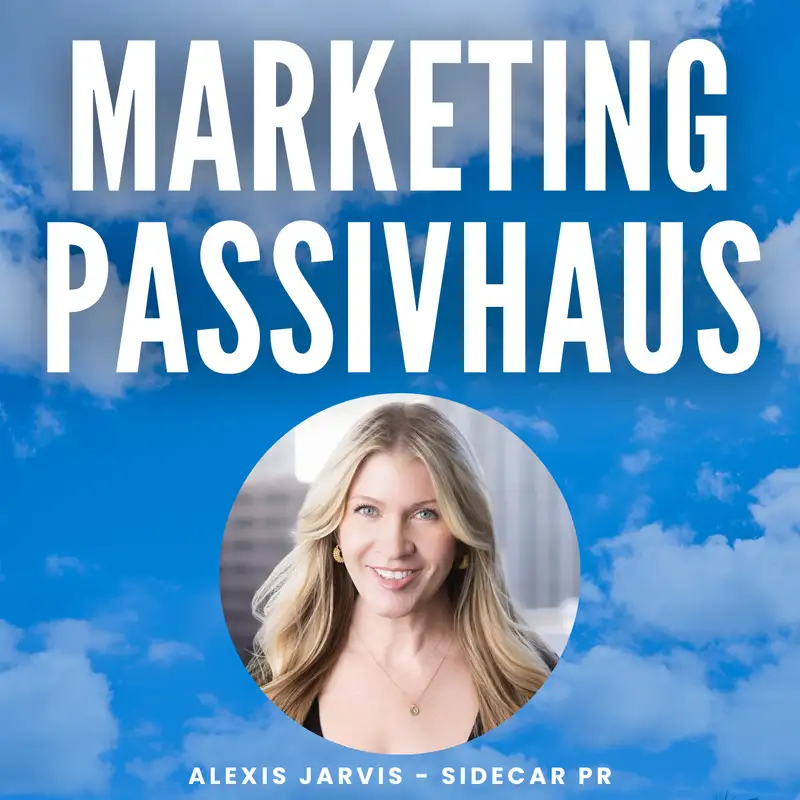
Alexis Jarvis - SideCar PR
27 - Alexis Jarvis - SideCar Public Relations
===
James: Hello and welcome to Marketing Passive House, the podcast where we hear from architects, designers, builders, suppliers, owners, and other experts in the passive house and high performance building space. We'll be talking about what's working and what's needed when it comes to marketing buildings that meet or aspire to the passive house standard. your host, James Turner, and today I'm joined by Alexis Jarvis, President at Sidecar Public Relations. Alexis, welcome to the show.
Alexis: Thank you for having me.
James: My pleasure. so before we get into it, and for people who are just meeting you for the first time, could you share a little bit about who you are, what you do, and when you first started interacting with the passive house world?
Alexis: Yeah, absolutely. Sidecar specializes were a pretty unique. Communications firm and that we specialize in real estate development, economic development, and placemaking. So for the last 15 years, that has been everywhere from investors and developers to architects, designers, lighting designers, builders.
Alexis: Anyone who touches the built environment, that is who we've worked with. So from a communications perspective, so I've worked in this industry for a really long time. We started working with the first folks who, everyone has talked about sustainability for years and years. The first time that I started to hear about passive house and passive building standards was probably about six years ago, five or six years ago, when we started working with Forge Craft Architecture and Design out of Austin, Texas.
James: Nice.
Alexis: they had really prioritized this. We've heard a lot of architects and designers over the years talk about building science and advances in building science and green building and various. Techniques or various features that a building might have that might fall under passive house.
Alexis: But the first time that we started really digging into what passive standards were was about five years ago.
James: Nice. Did you find instantly a wall of not sexy unmarketable things that needed to be messaged?
Alexis: Actually, I would say that the passive folks, the folks who, who put together the standards and you can get passive house certified, those folks have done a really good job of outlining what those benefits are. I would say that I've worked. In the building industry for the past probably 15 years.
Alexis: And the fact that I only heard about it about five years ago is, it was indication to me that there was so much opportunity to really get the word out in a bigger way about this. And it also indicated that it was probably gonna be a challenge. It was gonna be a differentiation point for sure, for this particular architect and design team.
Alexis: It was definitely gonna be a differentiation standpoint, but it was going to be challenging. For us to make sure that it, from a market awareness standpoint.
James: Na, that interestingly, something I thought that we'd probably talk about, and I feel like we got there almost right away from my perspective, is the distinction, and maybe you don't make one, but broadly speaking, the distinction between marketing and pr. So Sidecar is a PR firm, right? And
Alexis: That's correct. But because we are a full service communications firm, that means that we're doing website graphic design multimedia video. We're managing social. It really is, PR is the backbone, certainly. We're pitching media, things like that, things that people traditionally think of as pr, but we're also touching.
Alexis: All of these other aspects, and for a lot of real estate firms that don't have in-house marketing and public relations, we are the arms and legs for all of it. Primarily we're working on the earned side, so we're earning media placements and speaking engagements and awards and things like that.
Alexis: But we're also doing some work on the owned side the owned channels. We're doing a ton of work on website, forge Craft website, for example. We're doing a ton of work on social media, the things that they own and that they can put out to the market, whether that's in a paid capacity via advertising or that's, more what they're saying to the world with the channels that they own.
James: Nice.
Alexis: I'm sure that you've talked to a lot of architects and design teams and. A lot of times, maybe they have one or two people in-house. Even the larger firms, maybe five. But a lot of times they're outsourcing that. And what we found was it was much more effective for us to approach it in a holistic way to say, if we're developing a brand, we wanna be able to execute on that brand.
Alexis: And if we're developing a website, we wanna be able to continue to make sure that website stays robust and that, we're able to push out PR pieces on that website. And if we've got a PR piece, we wanna know that we've got control of all of the different channels to really make sure that it's going out across all of the different channels.
Alexis: So it was really effective for us to be a more holistic, comprehensive tool for our clients.
James: That makes so much sense. Yeah. You're, there's no point getting PR for cobbled together things that aren't gonna look good or read
Alexis: Exactly. Exactly. Or if it's a situation where, someone comes to you and they say, we have a project, can you get us press on this project? Yes, we absolutely can. We're gonna be more effective if we can do, multiple things at once. If we can do a video on the project and make sure, do an interview and push that out across your socials, it's just more effective.
Alexis: The way that people consume information is not just one way. We're not just picking up the newspaper, and so a very traditional PR approach, it doesn't even make sense anymore. So we have to hit people across all of the places and meet them where they are.
James: Yeah, absolutely. And great. And that's that is so great to hear. When you said that the fact that you hadn't heard about passive house like that's me think of it. It's not it is a marketing problem, but it sounds like it's al almost more of a pr, like an outreach being in places, being talked about in places
Alexis: I think that's exactly right. I think it is, LEED did a really good job of making it be the thing for a really long time that people knew about and it was something that people could, could check a box and, or cities could require or, it was a marketing tool. And in the same way, I think there is still a real opportunity to define why passive standards are
Alexis: the future and the way that we should be building, generally speaking, and to make it make it compelling for not just architects and designers who inherently know that they wanna build in the best way possible.
James: Yeah.
Alexis: know this. Everyone wants to build in the very best way to make it, really durable, long term and they want great air quality and they want to be able to do these things. It, the reality of the development environment is that it doesn't always pencil. And anyone who's worked in this industry knows that those sorts of things feel for many people like nice to haves that get value engineered out long term if the project is over budget.
Alexis: But if you're designing with that ethos essentially in the first place, and which is something that, that Forge Craft does that I think is really pretty amazing that they're like we're only going to design custom houses this way. Now it's not gonna be something that you value engineer out in the end, and we're gonna, we're gonna kind of stake our claim in that way.
Alexis: Which is both challenging I think, for them because there is still a lack of awareness, particularly in the in the consumer market for what this is. But it's also a really good opportunity for differentiation.
James: Did you find did you find yourself wishing that you could do PR at a broader scope something other than a particular practitioner? Did
Alexis: No, it's really, honestly, really exciting to, to you. I've, we've worked with many architects over the years. Many developers and designers and builders, and to have a real strong point of differentiation is always really exciting as a PR professional. Everyone can say We do people oriented design every because they do.
Alexis: That's what architects want to do, but. How do we really differentiate them in the market and how do we really say, what does that mean for, what does that mean for this project? What did people oriented design look like? What does it mean? And to be able to really point to some concrete examples of that is really exciting for us.
Alexis: So I would say it's, daunting to a certain extent because you're having to, for example, pitch media. So if I'm pitching media, they wanna see gorgeous pictures. That's always what's gonna sell the project. Yes. A story for sure. And we've got the story in the form of, they built the healthiest house in Texas.
Alexis: That's a great story. But if the pictures aren't great, and if the pictures, if the, if it doesn't tell the design story, they're ultimately gonna do it based on the pictures. And that's not all of that dissimilar from the way people make decisions. People want to prioritize sustainability, but in actuality, the way that they're buying, the way that they're making those purchase decisions is not based necessarily on those values.
Alexis: It's based on. Whether that is financially feasible for them and whether they really like it. So there is no substitute for great design. The hard the big challenge that we have when we're putting those pictures out and, our architects are designing gorgeous spaces like just, really beautiful spaces.
Alexis: You can't take a picture of good air quality
James: No.
Alexis: when you're, if a living room is side by side with another living room and they're trying to decide on that. A lot of times it is based on the visual. So it really it helps that they're great designers and so we've been able to get some really good hits, things and like dwell and, metropolis and.
Alexis: Publications that cover good design in general that can help us get the word out about this is, this is this gorgeous photo that you're seeing, but what you don't see is more important Here. What you don't see is that this has this incredible air quality and it's so much more efficient and the materials aren't offgassing into your, into your environment and your family's environment.
Alexis: But the pictures are the in.
James: Yeah.
Alexis: So you have to have those gorgeous photos, or you need to have something really, the more that we are able to use technology to take people behind the walls and behind the design, if you have a really cool animation that you're able to show.
Alexis: Those sorts of visual and multimedia assets are really helpful for your PR firm and your PR team as they're going out and pitching this to make it real for those editors who are seeing thousands of projects every day.
James: That's a very good point that the people that you're pitching PR to are looking at through a completely different lens from the people you're trying to reach.
Alexis: Yeah. Yeah. And wellness is a trend. Has been a trend, will continue to be a trend. If you look at the 2026 trend forecasting, almost all of them will still have something wellness related in there. The challenge for, from a housing perspective and for a passive house is people aren't making those decisions as frequently.
Alexis: You're not, I'm not deciding tomorrow, like this is something I believe in the next house that I get. I absolutely want it to be
James: Right.
Alexis: a passive house. You can't study this at all and not want that long term. But I'm not in a position to go build a custom house tomorrow or to go find that house tomorrow.
Alexis: And so I think it will take a while for the market to catch up. But the, for those folks who are in a, an economic bracket where they are and at are at a decision point in their lives where they're making that call,
Alexis: Think there's a really good opportunity to be marketing to those folks who are making decisions about what their next house will have.
Alexis: It's not typically that we found necessarily a, like a really great retrofit. You can do certain things in your house to make it more efficient and better air quality and things like that. There's absolutely those things that you can do. And there are those opportunities that we're pursuing from a pitch perspective where we're saying, what are five things that you can do in your house to start to move that direction if you have an existing house, 'cause you're not.
Alexis: It's tough to get behind the walls and kind of start fresh.
James: Yeah.
Alexis: So it's gonna take a while, I think, for that building stock to catch up. It's not quite like an electric car where you can say, that buying decision is a little faster, A house is different and so it's gonna take some time. And making it compelling to that audience for whom that is a real possibility in the very near future is first and foremost for us.
James: Nice. A couple of thoughts and then the. The fact is that we do judge books by the cover, right? Like
Alexis: yeah.
James: a book that looks quote unquote, looks interesting, and then it up and see how much it costs and make sure it's like not, a hundred dollars when we thought it was gonna be 15. And then read the back and try to see why this interesting looking book is interesting. Like you're applying your logic after you've made a heart decision based on. Just
Alexis: A hundred percent. Yeah, that's exactly what it is. And the financial piece of it is really and I don't mean to if you had another direction you wanna go, always feel free to stop me. The financial aspect of it is really, it's so important, not just for. The folks who might be buying a house, but it's really important for the industry from an educating the industry perspective.
Alexis: A lot of times the trades that you're working with that you have access to might not have those capabilities yet, and it's, it's education and awareness and marketing, not just to the end user, but to people who are making, who are building the buildings and who are deciding whether they're gonna develop that way or to cities who,
Alexis: Are investing in projects in their communities.
Alexis: Whether it's affordable housing or, multi-use buildings, civic buildings, things like that. If you can show them that long term, this is better and it's not gonna cost you necessarily more, the more that you get trades who are able to do that kind of work, the more the more prices come down and then the more it becomes palatable and mainstream.
Alexis: But it's not just like the custom industry that can do this, and it's not just the commercial industry and it's not just affordable housing. It really has to be everyone everywhere, all at once.
James: Have
Alexis: is tricky.
James: it is really tricky, right? Yeah. Yeah. And that's something that, that kind of, when I started this podcast, it was largely because I saw that marketing passive house as a thing is just so multidimensional and there's, yeah. I think of almost everything as marketing.
James: Like I, I think of
Alexis: Yes.
James: idea exchange,
Alexis: Yeah. It's communication. Yeah, totally.
James: To market to the trades, but it's
Alexis: yeah. I.
James: like they're gonna it, but they'll just see it and be like, oh, that would maybe be a really cool way to build. Or,
Alexis: yeah.
James: on a project like that, I'll be able to measure my performance or
Alexis: Yeah.
James: there's a,
Alexis: Totally. Totally. Or it's, it's skills development and oh, this is a really cool new way to build and not many people might have that skill. So that might make me really marketable in that sense, what does that look like? And from a, from a policy perspective, we're really interesting because we work, some on the municipal side as well and the civic side economic development side of things I'm thinking about, what does that look like when.
Alexis: Policies are being developed at the city level. How can policy better support these buildings that are better and more durable long term that stress the grid less? There's so many benefits to the city to having any building that has public funding. Being built to these standards. There's so many benefits to that, but it also has to, of course it has to make financial sense.
Alexis: So how do we bring those costs in? And how do we communicate that at the policy level to, a city council person who isn't spending their life in the building industry, who may be interested in some aspect of this. What are the messages that we're sharing the city council?
Alexis: What are the messages that we're sharing? About examples from other cities who have. Put together policies that encourage and incentivize this sort of building and design. And then what is the impact on that surrounding market that makes it easier for somebody who's building a custom house to get it at a comparable price to a traditional custom house.
Alexis: So
James: So
Alexis: it's fascinating. It's so fun.
James: how do you, so this is something that's I think maybe you have some tactical side answers, but like,
Alexis: Yeah.
James: get the, like when you talk about how do we tell the city council have you, are there some methods of PR and or marketing
Alexis: Yeah.
James: more effective at reaching those key people and.
Alexis: Yeah, so I would say, if you know that you have some expertise in this or somebody on your team has some expertise in this area, you're super passionate about it. You have the certifications, you have the credentials, essentially getting involved. And the way that we usually think about it is executive positioning.
Alexis: So where are those people from your team involved at a city level, a national level, a trade level, an industry level that's going to. Give them the clout that they need and the relationships that they need to go out and start having those conversations. There has to be the passion there and the will there.
Alexis: Otherwise it's not gonna, it's not gonna work. You can't just,
James: Right.
Alexis: Put out a letter to city council and hope that it works. There has to be those relationships there. And establishing some leadership in that area through executive positioning. Speaking on the topic, writing papers on the topic writing articles on the topic, getting known for the work that you're doing through your additional kind of PR and communications efforts.
Alexis: And then, if there is. In the case of Forge Craft and all, bring them up again here because they said, this is the flag that they're planting, right? They care about this, they really want to do this. They have a lot of team members on staff who are passionate about this, so they.
Alexis: And leadership in that area, and they were looking at some of these other municipalities that had put together pilot programs or policies that either incentivized or required that if you were using public funding, that it be built to a certain building standard. Like Passive House. So that makes total sense.
Alexis: So they brought that to city council and they brought that to a particular city council member who had demonstrated that they were maybe interested in that they had built relationships over time and they were like, Hey, we think this is something that could work for Austin. And they. To support that effort.
Alexis: We're putting together educational materials really in lay terms. We're putting together examples of other cities who have done this successfully. This really does make financial sense and practical sense and sense for a grid that is really stressed in extreme weather conditions to pay attention to.
Alexis: How we can be building these better. It's just a better use of money, right? So we're putting together those examples. With facts and figures and, options for how different communities have gone about it. And just presenting that as information and saying, if this feels like something that you wanna take up, this is how you might be able to do that.
Alexis: And in Austin, they did end up developing that pilot program from there. And that's gonna be something that is people are applying for their programs to participate in that in the coming in the coming years.
James: Wow. So
Alexis: it's really exciting, and then you hope from there that all these, all these trades are getting this experience doing this.
Alexis: And maybe it is a situation, hopefully it is a situation where it becomes more familiar. It's not scary, it becomes more economical. It's on par with everything, other ways of building. 'cause it is so hard to get a building built right now. Trying to build multi-family right now is next to impossible.
Alexis: Trying to get office built right now to certain standards is next to impossible. Like it doesn't pencil, so you have to make it pencil before anyone will pay attention to you.
James: That's really interesting to think of doing not science projects exactly, but
Alexis: yeah.
James: An act of marketing in itself, just creating the assets so that you have
Alexis: Yeah.
James: so that when that connection that you've made is ready, you can say here,
Alexis: Yeah, and then the evidence is there and then you have, five years from now, here's what energy costs are. Gosh, we did this in this city. If you're doing this in this city, this just makes sense to do. And for crafted, they've done a lot of that with affordable housing and they've worked with foundation communities for a number of years to say, okay.
Alexis: We know that you are not gonna charge your residents for, electricity, things like that over time. So you, it, you are incentivized to make sure that this building is as efficient as possible. And if they can do that with an affordable housing project, if they can put these, really ultra efficient.
Alexis: Systems and super tight envelopes onto an affordable housing project. And, they're doing beautiful design and it pencils for an affordable housing project. Like you really have no excuse to not at least be exploring it for anything else. And so it's, yeah, it's those little marketing points that, and those proof points that we can use when we're pitching down the road.
Alexis: But to, to the original point, it really is it comes down to can I award it and do I like it when it comes to people's purchasing decisions? Yeah.
James: Do you find that would you recommend clients to join find associations in their municipality and just join what they can thing?
Alexis: Absolutely. Yes, absolutely. And the thing about joining is that it's not just. Showing up at the meeting. It's doing stuff. It's making those relationships. It's building those relationships. It's saying afterwards, let's go out for coffee. Let's continue talking about this. What are those pain points for people who are making decisions at the city level?
Alexis: What are those pain points for developers? Understanding what those are can help you figure out what you need to do to sell them on a particular, a direction. 'cause you know that it's. It will work for them. You can figure out how to solve a problem for them, and that's really all that the networking ends up being.
Alexis: Or we're participating in, building panels and associations and things like that. You're figuring out how to solve problems for people and the best case scenario. And yes, you can talk about your firm in the process, but ultimately it's gonna make you most useful for people if you're getting involved and helping out.
James: Yeah. Yeah, I
Alexis: True.
James: like that it's, it ultimately just, it's just communication. It's
Alexis: Yeah, exactly. Yeah.
James: communication from sitting behind your desk and broadcasting, but going out and meeting the people and,
Alexis: Yeah. And listening. Like it real, it's listening. Yeah.
James: Yeah. Yeah. And there's that whole thing, right? If you. you accept that in order to do good or do anything useful in this world, you need to figure out like you serve people, right?
Alexis: Yeah. Yeah.
James: Dylan
Alexis: I'm so curious too, with you having this podcast, like what are those aha moments that have come through for you when you're, have a guest on who, who's you're like, oh, of course. That's totally what everyone should be doing.
James: Yeah I got into passive house like a decade before I started this podcast, and I've just been low key lurking on platforms because I've been, a copywriter and marketer. I've been writing websites and I at some point thought, probably the thing that I'm doing for all these like SaaS companies and tech companies, I could do in this. Industry that I'm really passionate about, and they need the same help. They're the, they have the same problems as tech companies. They've got complicated, brilliant solutions that the people who need the solutions need to hear it in terms they understand. So I think one of the aha moments was just realizing much of the Passivhaus-iverse is talking to itself.
Alexis: Yes.
James: terms that only people who know it would, which is totally, it totally makes sense and they're
Alexis: Yeah.
James: and there's nothing wrong with that. But it struck me that there was no, like I, I listened to the passive house accelerator the Passive House podcast, which is like the big one, and I love it. I most love the sort of few minutes, not sometimes it's longer, but where they talk about like how they convinced someone. To go for it. Oh, how did you get the council to sign on? Or even I always think about like one's partner, like usually there's one person who's really into it, and then if they're, if it's a couple buying a house or something, like the, one of them has to convince the other one that it's worth the extra effort or whatever to
Alexis: Totally. They're not going to have to sacrifice something. Yeah. Yeah.
James: like I really love those moments of conversation and I thought that probably there could stand to be more of it and just more of a. A platform for everyone sharing the moments where it worked
Alexis: totally.
James: and so think one of the. Going back to ahas for me, one of the things that has come up a couple of times that I hadn't really thought about was, and you mentioned it a lot, is that you need to have people who can do like builder.
Alexis: The work. Yeah.
James: to do the
Alexis: Yeah.
James: you're designing, right?
Alexis: Yeah.
James: so that, that was something that came up in, in a couple of different episodes, talking to people.
Alexis: It feels like a risk, right? Like you're, if if you're bringing in a contractor, it's always a risk and you're always, nervous, but you have to know that they can do the work, right? And so developing a really strong stable of folks who are experts at this is really important for sure.
James: yeah. And it an analogy for me being in Canada, not just Canada, but rural, like Eastern Canada, so not like Toronto. Wife and I are. Researchers of things, especially when we had kids and like when we make decisions, we research, oh,
Alexis: Totally
James: And
Alexis: it. Yeah.
James: the healthiest and the, and so often we'll get to the end of our research and then find that. no way to get the thing that we want because they don't ship to here. Or shipping would be, triple the price.
Alexis: Astronomical. Yeah.
James: it's the same sort of thing. I
Alexis: Yeah.
James: if you in a silo are like, passive house is a great idea and you get a,
Alexis: Yes.
James: Designer certification and then you go and you find someone who's yeah, that sounds awesome, but neither of you have checked what's on the ground.
James: And then you design them a house and then you realize that you literally can't
Alexis: Nobody can execute on that where you are. Yeah, totally. Totally.
James: was an aha that I hadn't, it hadn't occurred to me
Alexis: Yeah.
James: you need to which is what you're saying, everything all at once. Like
Alexis: Yeah.
James: things all need to happen for
Alexis: Altogether.
James: to work outside of California and the Pacific Northwest and now Massachusetts,
Alexis: Yeah.
James: these sort of hotbeds. We are not in a hotbed here
Alexis: Yeah.
James: in Fredericton, New Brunswick, not a hotbed of passive house. So yeah,
Alexis: tricky. Yeah, totally. You want the thing and you wish that people could build the thing for you where you are. Yeah. Yeah. And that's where I think the modular and just different building methodologies have such potential and as we're working with clients all across the country, there is so much potential there.
Alexis: That's finally starting to see some traction and it's. It's hard to say if it would've made so much faster traction if the past five years had been a little bit different. 2020 made things really hard. Financial situation made things really hard. We were developing like crazy before, and there was, I think, more of a willingness to push from an innovation standpoint previously.
Alexis: And so we're in a cycle where it becomes more of a challenge. People are trying to survive and so
James: Yeah.
Alexis: it's hard to. Convince anyone, and especially people who are lending on major projects to take a risk of any kind. And so that now becomes more of a challenge for us is, we can talk about why this is better all day long but it might not be something that is appealing to a bank lending for a major commercial project.
Alexis: And so there, there is a little one step forward, two steps back, but I think ultimately the case is there and so it's just continuing to identify those proof points and do everything that we can do to get the word out.
James: right. Yeah.
Alexis: That's another place where too social is like that. Sorry, that just made me think like
James: this is great.
Alexis: on the broadcasting from a broadcasting perspective and from a sharing information perspective, there are several.
Alexis: Folks who do a really good job fully nerding out and they are, to your point, a little bit, preaching to the choir about building science and some of this stuff. But there's really good opportunity to share. Via social media via multimedia, but like going in and doing we're, here's what we're doing right now and we're doing an air test where we're putting like fog throughout the house so that we can see where the little holes are.
Alexis: And those things make it real for people. And that's the kind of thing where that, if you have the. The will. There is absolutely a market for people who are interested in this kind of thing and who may be doing research and who may stumble upon it, and then fall down the social media rabbit hole like so many of us do on random topics all the time.
Alexis: That can help, get that word out and help you internalize those messages a little bit more so that maybe when you are looking for your next house, that you are making more informed decisions.
James: That's a good idea. Yeah. Yeah. I find that it's funny I, since I started following more and more passive house and building science people might LinkedIn feed, I only really use LinkedIn as
Alexis: Yeah,
James: Say what you will. But I I've dabbled, I never really got into Twitter, but I had
Alexis: at least you own your audience more on LinkedIn than a lot of the other platforms now, so
James: but following the house people, I have a way more fun LinkedIn feed
Alexis: Oh yeah.
James: there is that potential for like site tours and like
James: Installing things and it's
James: It's fun. It's
Alexis: yeah.
James: computer screens and graphs. Yeah.
Alexis: Exactly. And that's where there is still a lot of opportunity to take that a little bit more mainstream and meet people where they are. For the right people who are interested and committed to it. It is not. It is very time consuming to do something like a TikTok channel and do it well, but there's a ton of opportunity there for
Alexis: Science nerds to really get the word out to more people.
James: Yeah. And there's like the leading edge there, there's a space, right for that
James: Because the choir needs preaching too, as well.
Alexis: yeah, totally.
Alexis: Totally.
James: The people who are really nerding out will, it'll filter down and then
Alexis: Yeah.
Alexis: Yeah.
James: that weren't sticking to, to the choir. Let's keep that analogy. And then those individuals will have a, they'll be further along on their own journeys, so it's not.
Alexis: Yeah.
James: Yeah, it's not that there's, it's not, I'm not poo-pooing that, that side of things. I
Alexis: Yeah. But there's, and there is opportunity if the yeah. If the goal is to, for more people to know about it,
Alexis: To where those people are scrolling for hours on end just makes sense.
James: Yeah. Yeah. I was actually just talking about this recently with a, an architect in Portland and, was, he had been talking to someone and they were like, go to music festivals, like set up a little passive house assembly at counterculture, like different
Alexis: Yeah.
James: things where people are just gonna be like, that's what, and just
Alexis: are you most likely to find people who believe in climate change?
James: There's that for sure.
James: Yeah. But not just building, not just where
Alexis: Yeah,
James: of many builders, but where you're the only. House assembly or like the, I don't know, even just the idea of triple paned windows like these.
Alexis: Yeah.
James: It's almost sounds like a ridiculous, like a if we had, 10 x windows or whatever.
Alexis: paint with, yeah. Yeah.
James: like, there's in some way there's just this math, the joke of what if we had one more, but at the
Alexis: Yeah.
James: there's a really compelling case and I, but that having been said, seeing a triple pane window and how thick it is and seeing like it's, it, everyone has windows, everyone has interacted with windows and a high quality window is like. of nice
Alexis: Yeah.
James: something that's really secure. So
Alexis: Yeah. That's one thing that you can see and being there and able to recognize that tangibly. Yeah.
James: Yeah. Anyway I just I like that there's space for that. And if some sort of alternative thinking, you can show up places where no one is and 'cause a part of what I extracted too, from what you were saying is that there's a demand generation. Need.
Alexis: Yeah. Yeah.
James: know that this is even a thing. That you can
Alexis: An option. Yeah, or an more than an option, like it's the air quality piece of it. To hear folks talk about the difference. It really is like it should be a standard. It should be something that, when it comes to the materials that are used and making sure that the materials that are used that you're bringing into your home are healthy.
Alexis: Like you do so much research. You and I both like as parents, we do tons of research, right? And about, exactly what our kids are putting in their mouth or the clothes they're wearing or what, what sorts of materials are touching them. But then our house is this whole other thing.
Alexis: We're like, I dunno what this wall is made outta. I didn't even know that's something I should be stressed about. And so it's not a fear tactic necessarily, but it is a point of education for sure. And I think for people who are committing to hardcore wellness in their life, there is an opportunity to be like have you thought about this part of it?
Alexis: Is. You know the place where you are sleeping at night and
James: Right where you spend all this time just.
Alexis: you spend all this time here. Yeah. Yeah. Absorbing. Yeah. Totally.
James: remember well talking, so Trey from Forge
Alexis: Yeah.
James: he was on the podcast and that's who we were talking about earlier, forge Craft. He made, he, he made the, an analogy of just like people spending all this money to have organic, like grain
Alexis: Yeah.
James: lattes and the, spending all this. Effort to make sure that you're trying to be as eat and drink as clean as possible, and
Alexis: Yeah.
James: why not? Then
Alexis: Yeah.
James: breathe
Alexis: yeah, if air, if the air around us was a color, I think it would be much easier
Alexis: Like we can see smog, but we can't see when our indoor air quality isn't great. And there are. Having a gas stove and you're not seeing the stuff that you're breathing in necessarily, and that makes it harder to convince people that might not be the best way to go.
Alexis: Yeah. And that's where, yeah, like those side-by-side pictures, you're pitching Architectural Digest and they have side-by-side pictures. You not only have to have the coolest story, but you have to have the best design. And I wish that I could, I wish that I could make the air a different color for photos and demonstrate the difference, but yeah, until we get to such point that I can do that.
James: We're, we are where we are. We can
Alexis: Gotta rely on really good pitching. Yeah.
James: Yeah. This has been great. I feel like we could go for another episode's length, but to be mindful of our time and the listeners' time, I think we should probably wrap it up there. Where is the best place for people to go and find, connect with you and find more about Sidecar
Alexis: Yeah, you can connect with sidecar@sidecarpr.com and you can connect with us across all the social channels via the same handle Sidecar pr. And we would love to, to hear more from this community. This is such a fun area and I do really think it's the future, so we're excited to, to continue to explore.
James: Awesome. Thanks so
Alexis: thank you so much for having me. Thank you so much. This has been great.
James: My pleasure. You've been listening to Marketing Passive House. I'm James Turner, and I hope you'll join me again next time.